Maybe it’s time we did a little more thinking about how we feel when encountering artworks, exhibitions, and diverse other aspects of the art world. Feelings felt by audiences, as well as those felt by artists, can all be considered relevant during those key times art comes into being and subsequently gets to be perceived as art. Art evolves, in part perhaps, because of this emotion-led element.
But, thinking about Cross Lane Project’s new exhibition which (thanks to that word ‘not’ being placed slap-bang in the middle of its title) seemed to consider thought irrelevant or unwelcome, I have to admit my personal feelings as I travelled to Kendal included some apprehension.
The fact that this troubling title originated from Anthony Corner’s central contribution to what is actually a group show did, however, shed some light on how this extremely varied selection of work was assembled and its layout planned. Corner’s practice is distinctive, and his career is advanced, and so the headlined thought-free approach could well be considered to have had some autobiographical and reflective significance in generating everything he, at least, makes. While I was not so sure the phrase ‘felt not thought’ conveyed an accurate definition of all the other works on show, one work in particular, for which Sarah Kent and Sharon Leahy-Clark were jointly and interactively responsible, only came into existence as the private view unfolded, and this spontaneous event was probably more a product of feeling than anything else that the gathering crowd encountered.
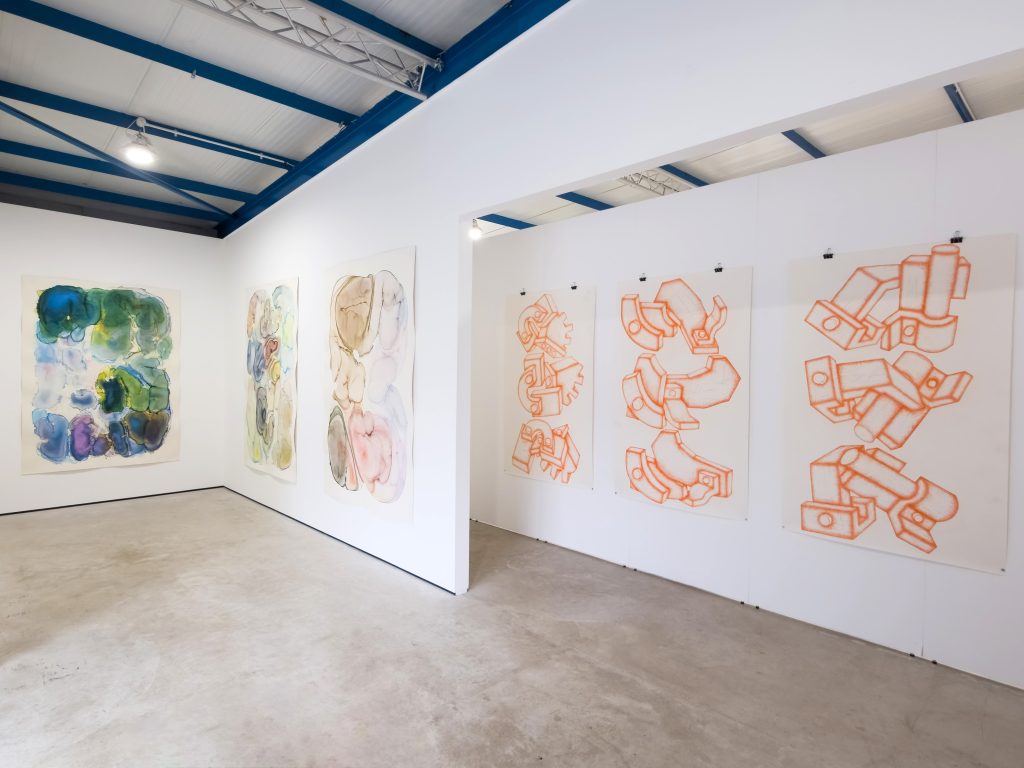
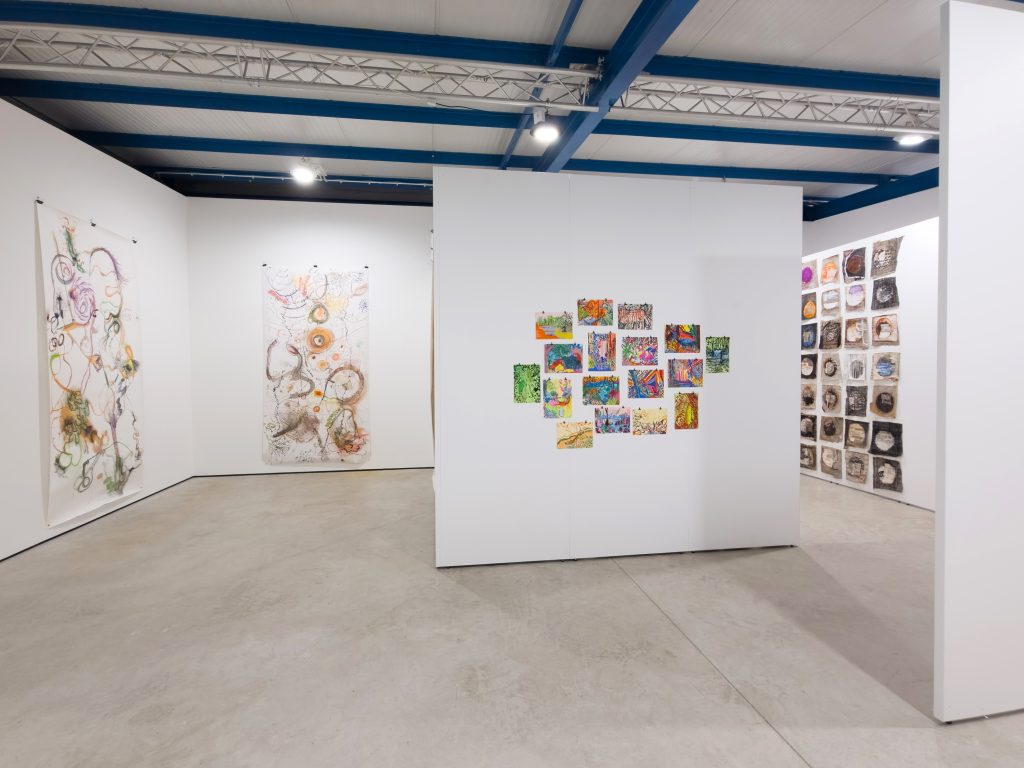
Cross Lane Projects’ former factory space has allowed room for this exhibition to adopt a layout using a series of temporary walls, turning inwards to the left and then to the right, revealing artworks stage by stage, and contributing to the show’s, exploratory and ‘felt’ nature. This arrangement added a sense of discovery, but to some extent it has isolated work by one of the artists, Barbara Nicholls, which has been placed in a sort of antechamber to the left of the entrance to the rest of the exhibition. Nicholls’ large, recognisable abstracts are made with watercolour pigment that has been pooled and then dried by electric fans, leaving strong-edged layering and subtle, dramatic forms, bringing to mind half-remembered images, in my case recalling old Ordnance Survey maps, cross-sections of tree trunks, or x-rays of plant structures. Often, Nicholls’ colour-forms overlay or collide with others, and everywhere the resulting collisions produce shining variegations of violets, greens and blues. Works like ‘Magma Ocean’ (2016), or ‘Shock Metamorphosis’ (2015), immediately attract attention: you want to approach them and examine in detail their intensity and delicacy. If you want to know how I felt, I would say ‘unsettled’, or at the opposite extreme, ‘reconciled’. But then I returned to the rest of the show, which attempted to connect with the viewer on a series of very different emotional levels.
Facing me next was John Plowman’s series, ‘Hybrid Construction Details #1,2,3’ drawn in red coloured pencil on card – playfully twisting and experimenting with the possibilities of inventing imaginary, semi-industrial, hybrid objects that seemed to have been designed with some practical purpose in mind, each part outlined with elaborately cross-hatched edgework, and all eccentrically juxtaposed and randomly riveted. They possessed a cartoon-like energy that was appropriate in introducing much of the ad-hoc, instinctive elements within the show that unfolded as I gradually proceeded further.
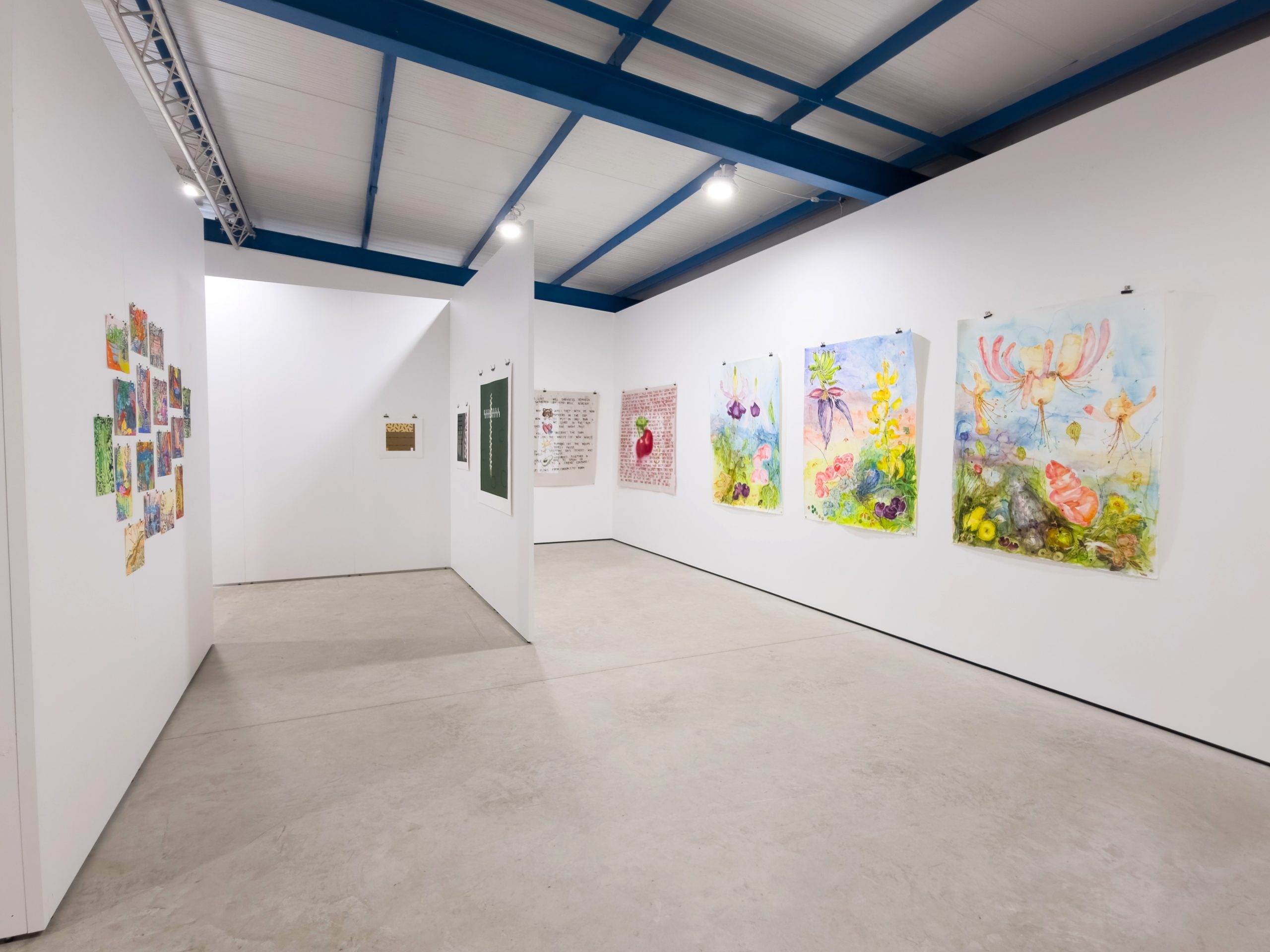
Stella Whalley’s large-scale watercolours depicting dangling flowers, fallen fruit and the complexities of undergrowth, all made deliberate connections with locations around Cumbria, including ‘Wast Water’, ‘Langdale’ and ‘Ashness’ (all 2026). In each case, the lusciousness of drooping petals drifting and, in some cases, pointing like alien spacecraft amid airy, breezy surroundings, dominating the unexplored dark of what lay below, all suggested a complex and perhaps disturbing set of reflections on sexuality and identity.
So far, I had experienced quite a few different feelings. I kept checking what these feelings were, and which artists’ possible feelings were affecting my own. And the questions continued: did any feelings I was having depend on actually liking the work? So far, I had been provoked to laughter (by Plowman) made positively reflective (by Nicholls) and oddly disturbed (by Whalley). But Alex Giles’ super-concentrated abstracts reminded me of ‘hard-edged’ geometric painters from the USA of the 1950s and 60s, such as Al Held or Karl Benjamin, and like them, Giles’ work takes you into dream-like, semi-spiritual states with accompanying feelings that take time to define, and must therefore be remembered and thought about. Feelings demand a certain amount of analysis.
I had to put these thoughts to one side while contemplating two works by Rebecca Scott (who also curated this show, and who co-established the Cross Lane space with Mark Woods in 2018). Both works reflected the artist’s ongoing interest in text, applied here by using stencils, in lettering that is entirely capitalised. This makes the spacing between words variable and the effect of the words harsh, almost dictatorial – appropriately, perhaps, in the case of ‘Skin and Hair’ (2025), in quoting from the late South African writer, Nadine Gordimer, on the subject of skin and hair differences and racist apartheid legislation. Here, the text was precariously arranged around the crudely, almost cruelly, coloured image of a pair of ripe cherries with leaves: an unsettling history lesson with a disconcertingly gaudy but crudely enticing centre-point.
Emotionally disconcerting, too, was Ashley Beerdat’s ‘When Colours Dream 1 – 17’ (2026), a series of oil pastel paintings, which certainly contained the power to evoke some of the images experienced during sleep, perhaps because of their collective title, but to an even greater extent, because of their fecund and overflowing appearance. Evidently, Beerdat is also centrally concerned with the environment and today’s threats towards its stability and survival, and that is certainly relevant to the Cumbrian location of this show, if only in demonstrating how a future mix of genetically modified plants intermixing with an over-visited or unwittingly polluted natural wilderness could unfold and develop in disturbing ways over time.
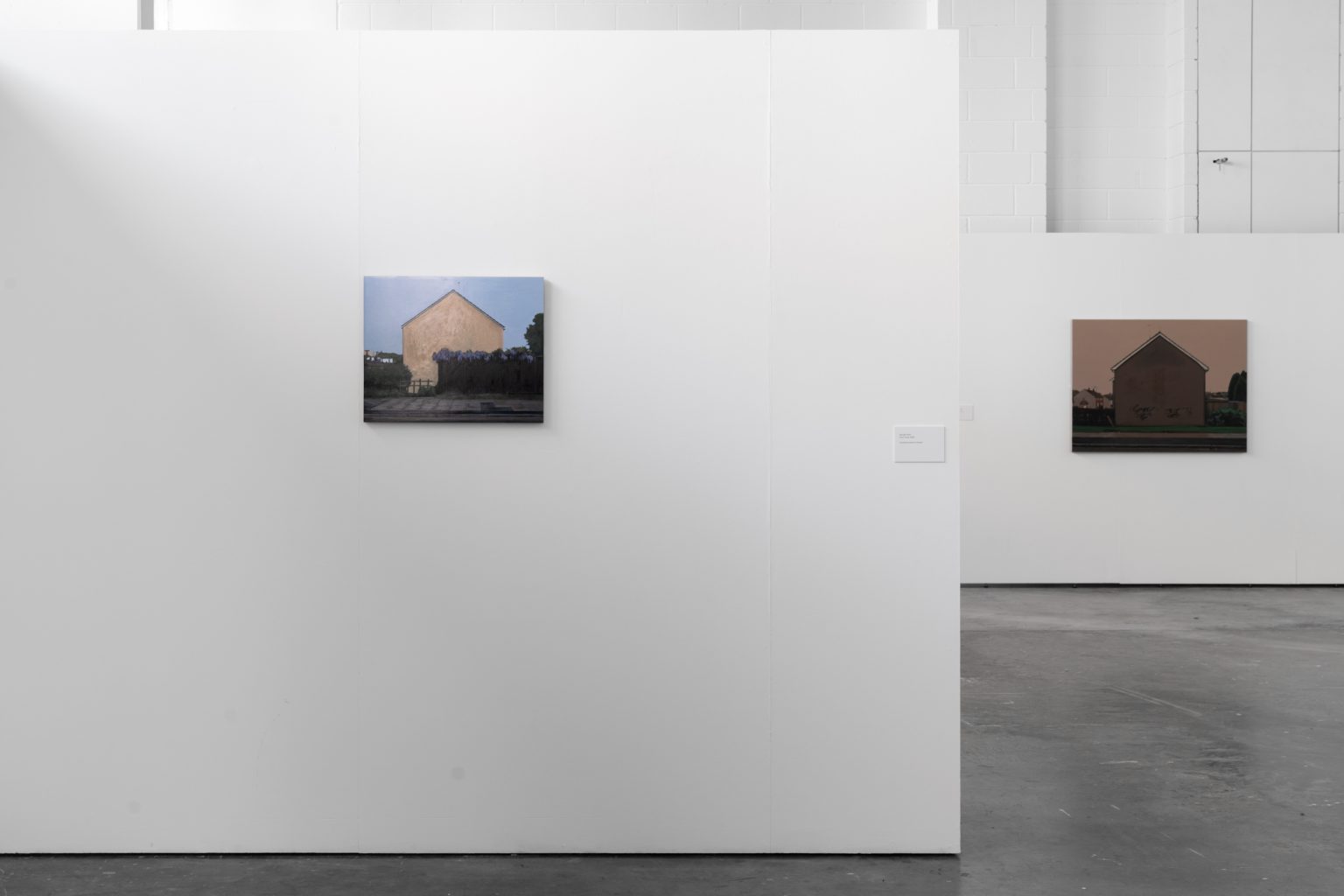
Echoing the formality of Alex Giles’ nearby work, the late Gerard Hemsworth’s inkjet prints, ‘Suburban Garden (Green)’ (2009), ‘Grass and Bunker’ (2016), and – striated with lines of barbed wire – ‘Little Bunker’ (2018), all seemed surprisingly sinister in their sharply focused semi-abstractedness, centrally concerned with natural and domestic observation but decidedly witty, and circumspect, too.
I was considering the combined, and still-accumulating emotional impact all these artworks were having on me when my ears and eyes began to be attracted by the live element that was gathering momentum in the furthest corner of the exhibition space, where an increasing number of visitors was beginning to crowd around to watch what was taking place. Here, crouching or kneeling, then moving around and quietly discussing what to do next, Sarah Kent and Sharon Leahy-Clark (in matching Haute Cuisine T-shirts) were getting increasingly involved in their Private View Live Performance, by making marks on a big, floor-based sheet of paper, using graphite blocks, pencils, paint and felt tip.
The resulting abstract forms were beginning to develop into something complex and compelling as both artists found places, junctures and opportunities to add more. At one point, one visitor said to me, ‘I like how they draw with two hands at the same time, as if it was a piano or something’. And there was a feeling, at least in my mind and body, of experiencing something ambidextrously produced by two people, and made in ways that were aware of a social context, as well as being produced in the moment. Rather like music. It was fun to witness, and later, as the opening drew to a conclusion, the resulting work was hitched up on to an empty wall to great applause.
At the centre of the space, visitors reached Anthony Corner’s mixed-media installation, which provided the show’s title. His work here included much that had been collaged and modelled out of paper and card, and it also featured manufactured objects like picnic plates and bowls, arranged, especially, along parts of the floor bordering the vertically-positioned elements of the artwork, which act like walls – the sort of walls that have received generations of graffiti, redecoration and added signage. Walls, in other words, for all kinds of instinctive and emotional drives to find form.
Corner’s surfaces frequently included a hand-painted label nearby, some examples of which carried sensorily provocative mottos like ‘fizz bang,’ or at the opposite extreme, ‘a hint of offal’ – the latter probably referring to Corner’s teenage past in Australia, when he worked for a time in an abattoir. But over a great many of these paper surfaces the artist had accumulated multiple markings, including daubs or layers of paint, frequently with additional scribbles, doodles, areas of cross-hatching, or patterning, some examples of which were made initially on lined notepaper and ripped into tiny dimensions suitable to be added to an already built-up surface. Sound frequently came to mind as a result: in the use of painted words but also in the materials the artist had shredded, the way he had applied his marks, the repetitions as well as the excisions.
Corner has long been fascinated by the binary nature of language and communication: the decision, for instance, for a paint-brush or a pencil to go one way or the other, resulting in the amassing of text or markings, but also, along the way, the corrections that sometimes have to be made – the crossings-out, the bits of overpainting, and all those other reworkings. The result here was a compelling mix of grand affect and tiny detail that sometimes persuaded the viewer to crouch or kneel to decipher some small piece of handwriting. The complexity of these surfaces fascinated many visitors at the opening, several of whom lingered here a long time, investigating details and discussing it all with each other.
And I for one could not avoid joining in. I could see how Corner’s work has in the past transitioned so well to the stage, having produced sets and costumes for the Royal Opera House, for instance. But – just as much as Kent and Leahy-Clark’s performance-painting, Corner’s work also makes music come to mind, in its subtle and insistent exploration of contrast, detail, atmosphere and ever-changing rhythms.
I was also pleased to see that this was a dog-friendly opening (there were three I noticed, all on leads). But Corner’s paper bowls seemed to attract little canine attention. His was all work to provoke human sense and emotions.
Felt Not Thought, Cross Lane Projects, Kendal, May 16-July 4, 2026. Including works by Anthony Corner, Gerard Hemsworth, Barbara Nicholls, John Plowman, Stella Whalley, Sarah Kent and Sharon Leahy-Clark, Rebecca Scott, Ashley Beerdat, Alex Giles.
Bob Dickinson is a freelance writer and occasional musician.
This review is supported by Cross Lane.
Published 03.06.2026 by Jazmine Linklater in Reviews
1,840 words