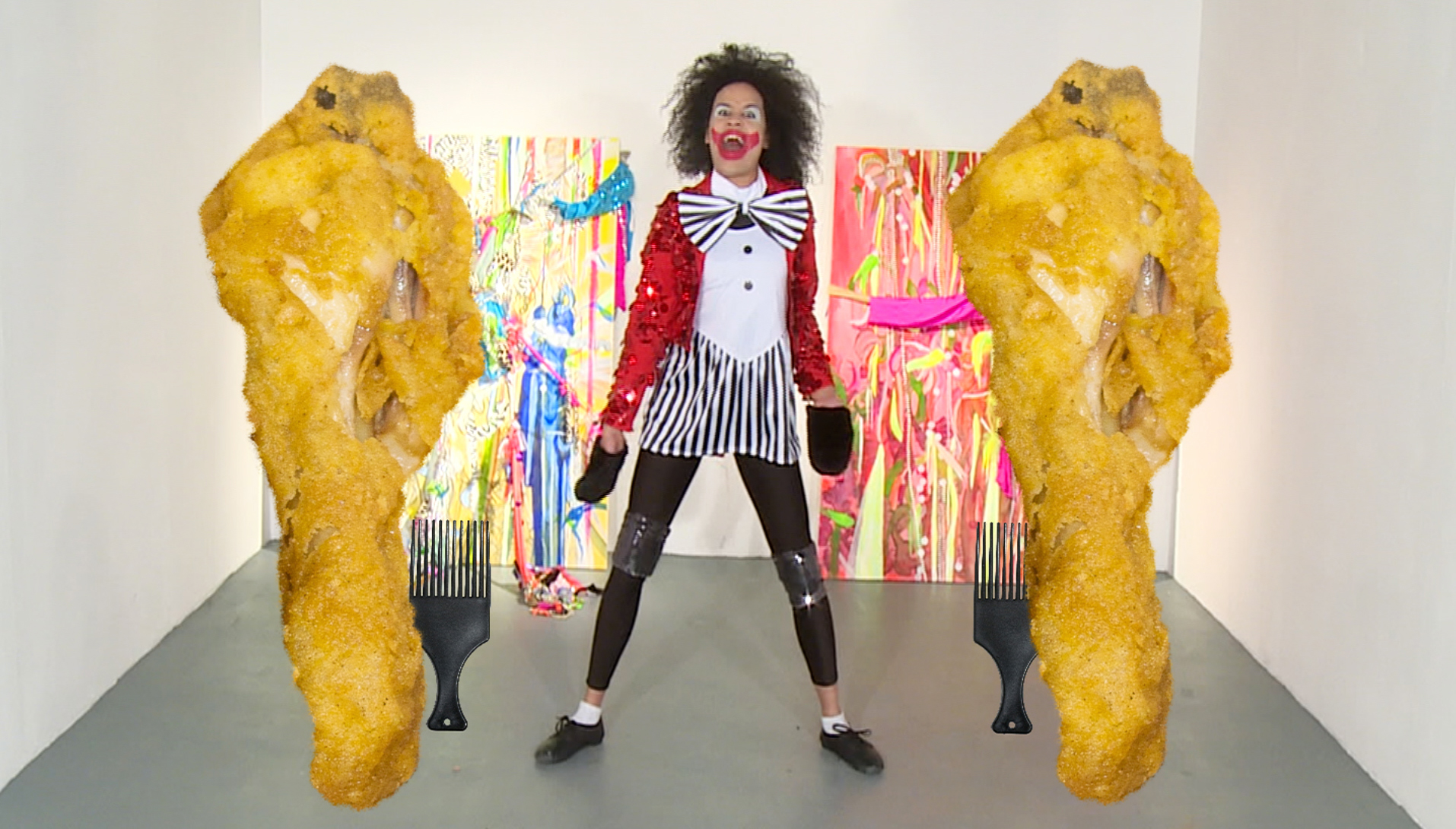
Quilla Constance, aka QC, is a British-Jamaican multi-disciplinary artist whose work reckons with her mixed-heritage identity, societally imposed stereotypes and the hegemonic structures that shape society’s thoughts and behaviours. She is perhaps best known for appearing in Sky’s television series Rob and Romesh Vs..(Art) (2021), in which the artist is filmed in a live gallery performance standing, bending stiffly at the knees holding a pair of fake breasts to her chest, emitting sex noises. She’s not for the easily offended.
Activating Intersections, the artist’s new solo exhibition at New Art Exchange (NAE) in Nottingham brings together a selection of paintings, installation and recorded video performances from over a decade of practice across two gallery spaces. QC combines carnival, punk and Dada sensibilities intersecting with contemporary dialogues on race, power structures, histories and gender, to reassert Black-British and marginalised identities that challenge social norms. The exhibition also represents a move away from using herself as the disruptive agent and extends it to other Black women.
Activating Intersections draws on QC’s long-standing activist practice and socially engaged workshops at Tate Modern between 2019 and 2020, in which over 1,000 diverse participants were invited to wear QC’s costumes and use socio-cultural props such as bone china tea sets and cassava (a staple of Caribbean cuisine). The participants read from scripts to create impromptu performances, asking: ‘what is British society now and where are we going?’
Some of those costume-clad participants are the subjects of QC’s 8 larger-than-life paintings that hang in the first exhibition space at NAE. Black women, including QC, alongside a little white boy are pictured in tableaux dressed variously in historical gowns and QC’s uncategorisable DIY costumes. The figures are situated in grand stately homes, but the backgrounds are subtly cut-up and have a flatness reminiscent of theatre sets. Mr Kipling cake boxes, tea sets, carnival-wear, pineapples, dogs, and ackee (a soft fruit from West Africa that is used in Jamaican cooking), are either props or part of the image.
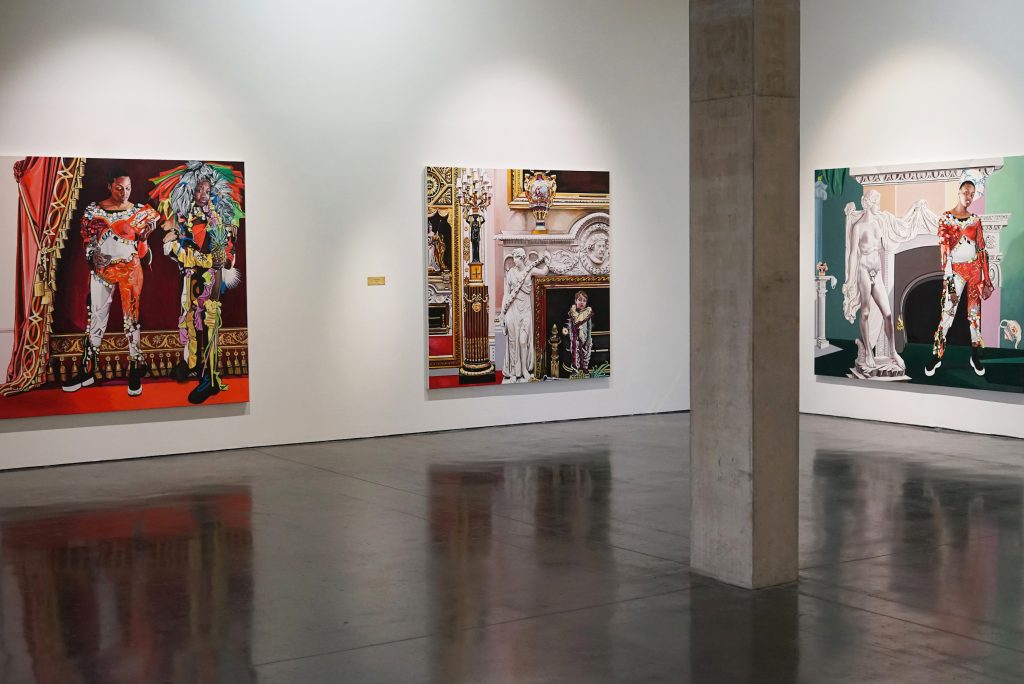
In ‘Sister Signifier’ (2023), a woman stands in a red and white sequinned jumpsuit looking at a Kipling cake box, as if reading the ingredients, unconcerned by her red-curtained, backstage theatre-like surroundings. In ‘Buckingham Bling’ (2026), a woman lies across a dressing table, rollers in her blonde hair, the Imperial State Crown atop her head and the Sovereign orb and sceptre lying next to her reclining body. A chandelier swings in the background and a fluffy corgi stares out from under the table and there are markings across the skirting boards that could be derived from ancient cave drawings. The figure appears so totally nonchalant that she could almost be at home, comfortable on her own bed. The subjects seem to be at once ‘playing’ at being the elite through architectural and object association and also mocking it through ‘incorrect’ dress or ‘improper’ conduct. Belonging is born out of this duality and gives the characters an extraordinary sense of ease in traditionally exclusionary spaces.
Three paintings represent a Coronation ceremony of sorts, yet all three of the black women depicted wear feathered headdresses in the place of a crown, while their clothing and the backgrounds compress culture and time, and to me they evoke images of the Roman Empire, British Empire and post-Empire associations. Another painting ‘Coronation 1’ (2026) depicts a striking image of an imagined character called ‘Dame Scotch Bonnet’ smiling out at the audience in a huge Jamaican-flag inspired feathered carnival headdress and fantail. Wearing a Union-Jack bikini top and matching tasselled mini-skirt she holds up a Burberry-tartan handbag. Standing in a dilapidated Roman villa with a crumbling statue, she is resplendent. ‘Coronation 3’ (2026) catches a different queen in a quieter moment, standing in the centre of a round, primrose-yellow, ornate wooden panelled room, she looks outward with calm determination. In a blue ballgown with her hands above her head, she holds a feathered headdress aloft, about to crown herself. To her left, a bulldog tucks into cream cake. The third coronation painting is set in an empty, grey ballroom with a reflective floor, a young black girl in a ballgown and trainers, crowned with her carnival headdress spins gleefully while a confused Basset Hound looks out at us from the picture frame. It pits the more egalitarian, annually-changing carnival queen tradition against the unelected and hereditary long-term rule of monarchy. QC’s scenes are boldly anti-establishment and by ‘playing’ them on and with Black women, they point to ideas of anti-colonialism and re-claiming power. These images acutely address an empowered intersectional identity and how context plays a part in constructing that intersectionality. It reaches to an expanded form of intersectionality that brings in histories, power structures, tradition and cultures alongside personal traits of skin colour, cultural heritage, age and gender.
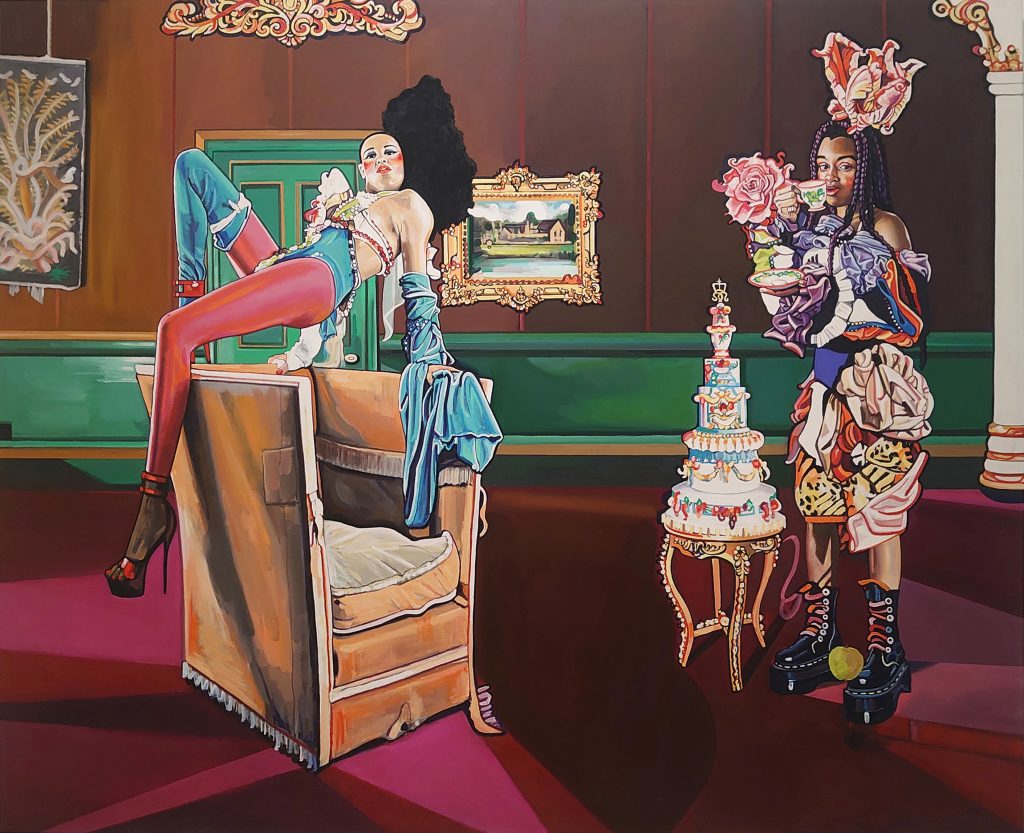
As I navigate the exhibition, understanding unfolds: heritage spaces become symbols of oppression, surreal acts or objects, such as standing on a pineapple or the presence of an intersex Roman statue, become moments of possibility that disrupt the inherited meaning of social codes. QC’s examination of such structural codes extends to the act of painting itself. This is evident in the commanding size of the canvas, the reclining figure as a trope in canonical art and the brass plaques used in the place of artwork labels that give the paintings their quiet, authoritative status. The artist’s paintings are a joyful expression of intersectional marginalised British identities that subtly portray how subject positions become constructed. They present figures who seem to possess a distinct agency within power structures, and in turn speak to pride and rightfulness. Ultimately, these images function as theatrical performances, existing across two spaces: one of possibility and one of absurdity, and in the slippery tension in between.
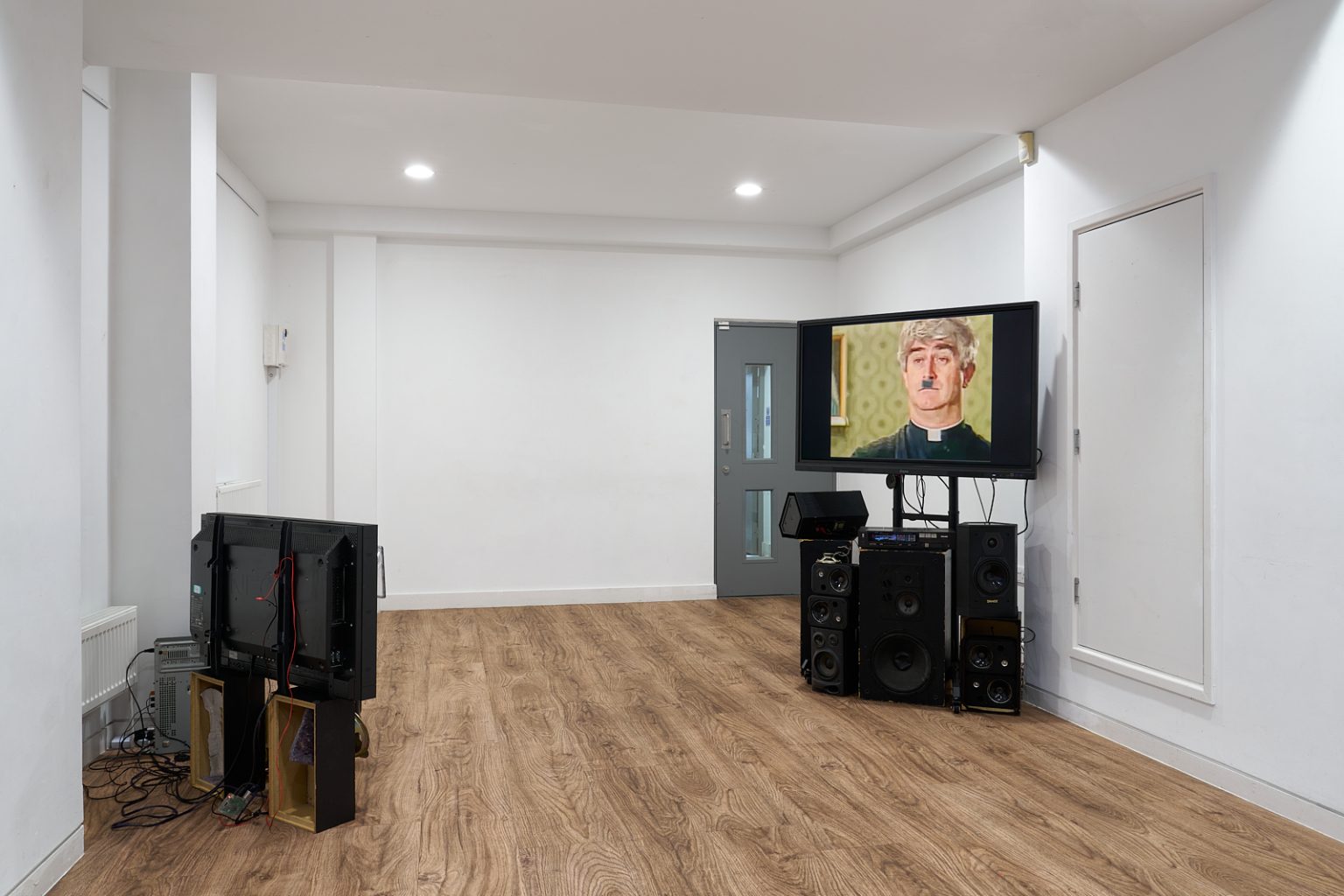
Intersectional ideas are present in other moments in the exhibition. In an adjoining gallery space, three television screens play a looped selection of QC’s video works: ‘PukiJam’ (2015), ‘PR Blitz’ (2014) and clips from her QC appearance on Rob and Romesh Vs..(Art).
‘PukiJam’ is a nonsensical song set to a techno beat that varies in tempo, accompanied by QC dancing in a minstrel themed costume in front of previously unseen paintings in a studio setting–she affirms her position as a female artist of colour whose identity is caricatured by racist tropes. Images of fried chicken, afrocombs, jam tarts and other stereotypical symbols of Blackness and Britishness are digitally superimposed alongside the artist as she dances. Filmed variously in her studio, in a poorly furnished bedroom pasted with images representing idealised female beauty, and in a wood panelled room having high tea, QC plays the cello without melody and drinks Red Stripe beer as she paints. Her ‘singing’ is gobbledegook, reversed, sped-up and slowed-down. The film shows an abstract performance both navigating the intersections of being an artist, a performer, and a Jamaican British female while resisting the categorisations that come with those identities. The audio switches in speed and the length to create a deliberately nauseating experience.
In one scene, the artist, guised in modernised minstrel make-up and deliberately uncombed hair sits next to a large poster of a group of white, perfectly groomed Miss England contestants. She does her best to look like she is part of the group, emulating their passive smiles and non-offensiveness. I find this scene hilarious for the heightened and ridiculous attempt to fit into such homogeneity when the physical differences between the artist and the women in the poster are stark. Her attempts are clearly futile. This brilliant visual comparison, a key moment in the exhibition, addresses the intersection of Euro-centric beauty ideals on looks and race, highlighting how silly, and ultimately harmful such structural biases are.
The film ‘PR Blitz’ shows us the artist oscillating in both a junkyard and dingy bedsit, with celebrity tabloid newspapers strewn all around her. She sings over an edgy guitar riff, repeating what sound to me like tabloid headlines: “Beth Ditto without her kitto” and “Simon speaks exclusive interview on fatherhood”. QC amusingly performs such lines about topless women while shoving a pair of fake, nipple-crusted breasts into the camera. The film ends with the artist playing a whiteface character shooting herself in the head with a plastic gun. It disorients as it pokes at the media’s male gaze construction of celebrity women as throw-away objects for entertainment.
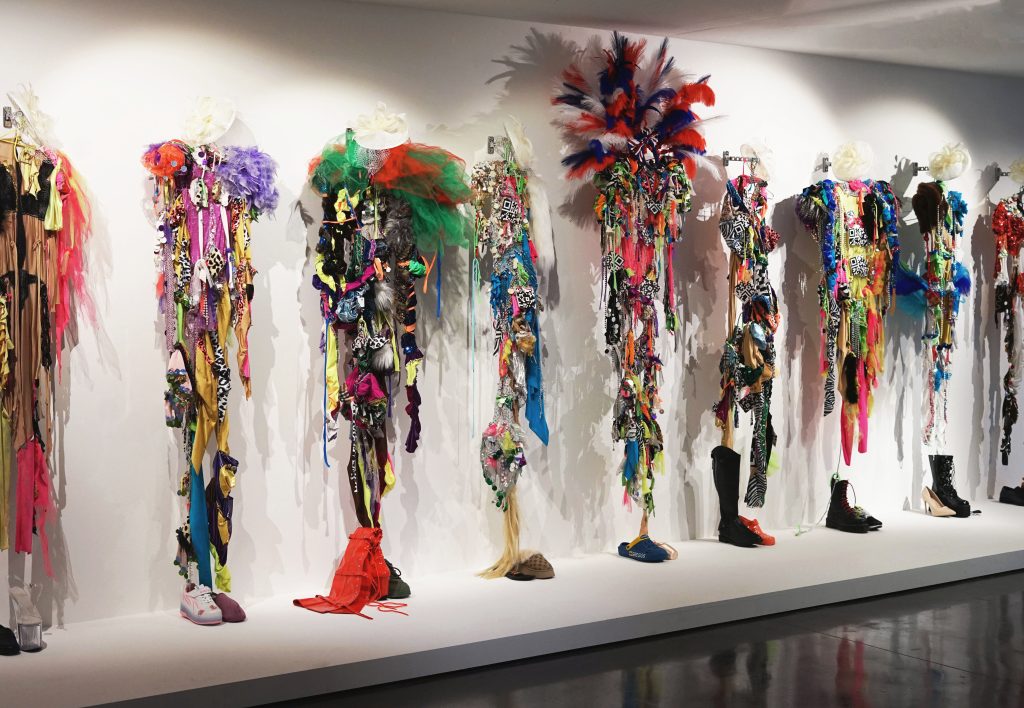
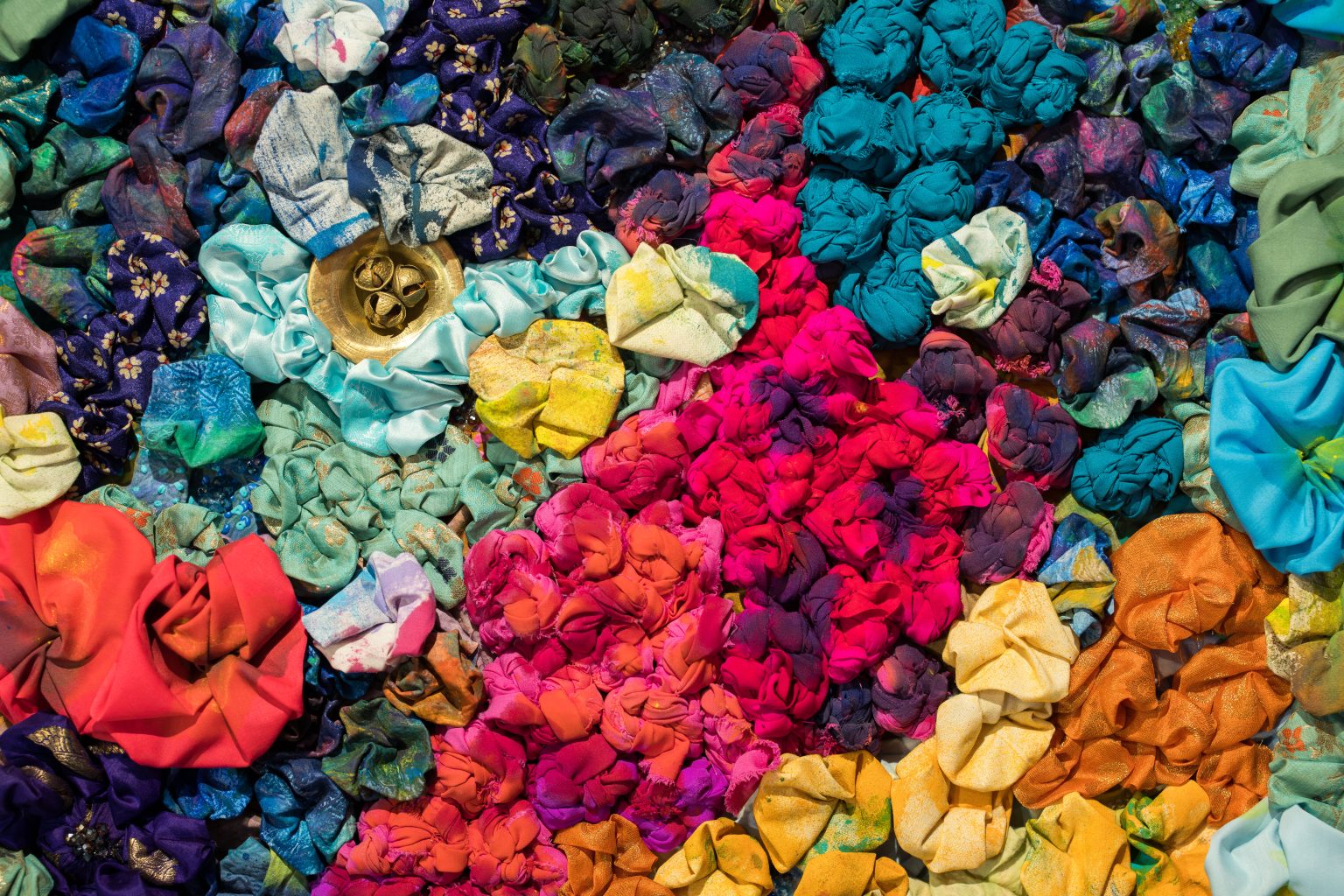
‘The Grenadiers: New Regiment’ (2026), an installation of nine costumes hand-made by QC, hang without mannequins to give them shape. They present as a limp assortment of scavenged and stitched fabric scraps waiting to come to life. The textile assemblages made of fluorescent body suits, velvet, nets layered into epaulettes, strings of pearls and laminated QR codes are an excess of leftovers from consumer culture. It’s the shoes that tell us that these are theatrical outfits. One costume features a red, blue and white feathered headdress, completed with a farcical pair of mismatching shoes that bookend the British class system, a ballet pointe shoe and a Greggs-branded foam clog. The mismatch flattens preconceived ideas of taste, class and fashion, yet while they feel humorous in their pastiches of class, taste and consumerism, for me the costumes lack the visceral animation of the artist’s paintings and video works.
QC uses her personal experiences as a Black female, artist and performer to offer a more forthright experience of intersectional identity using deeply personal traits, all of which appears to sit in contrast to the subtlety of the artist’s paintings. This tension sets up a tussle between QC and the artwork: whether both the paintings and the videos present their subjects in equal measure? It’s an unresolved tension and hangs across the galleries. Where QC is seen radically resisting hegemonic structures by acting against them, the painted subjects are navigating within these power structures. Are these differing levels of agency or agency with different modes of operation?
QC critically evaluates the power structures of her work, successfully leveraging it with an institutional opportunity to make visible marginalised communities. This suggests that it’s the latter interpretation, but it does raise an interesting challenge about how far a person has must go to resist categorisation.
Opened during Black History Month, ‘Activating Intersections’, added to the month’s conversation by addressing intersectionality as a discourse that is best understood through situations. The exhibition presents itself as a methodology that uses abrasive and tacit techniques to rescue intersectionality from being flattened into identity markers. Through differing media, QC reveals the relationships between identities, spaces, objects, power structures, social influences, histories, tradition, culture, assumption and unawareness. This is an important reminder of the systemic power of all these things, even for the initiated. The artist’s full appraisal of visual, spatial, structural and behavioural languages challenges assumed identity constructs and creates room for a unique and highly stylised vision of self-authorship within these structures.
While successful and bold in navigating such a delicate subject, I feel slightly unsure about what I should take from the exhibition beyond, simply, an understanding of the breadth of the topic. Should it inspire me to also perform myself in out of ‘character’ ways to deepen my intersectional understanding or sharpen my ability to read objects of socio-cultural status? Probably both, and the kitchen sink, for the artist asks a lot of her audience.
QC’s work does successfully activate in the exhibition spaces at NAE which feel brashly energetic and challenging while I am exploring the exhibition, but I leave wondering whether this has gravity beyond the walls of the gallery to carry through into the ‘real’ world. At times, the use of ‘self-presenting’ feels to me a familiar artistic device of the last 4 years. This is equitably so, given the increasing public awareness of the experiences of marginalised communities post-COVID and post-George Floyd and how socially engaged art centres people as its medium. To boot, galleries now favour socially aware exhibitions as they bring a more diverse audience to their doors, and this is a good thing. Though, coupled with the images’ visual hinging on heritage spaces, I found myself wondering later what impact this has now that the conversation about intersectionality has moved on to more contemporary connections. Moments that punch through have a distinctly contemporary context, like visuals of well-known brands like Greggs, balancing this with disciplines like ballet or the influence of modern media outlets. It is easy to interpret embedded hierarchies in Buckingham Palace’s stone worked fireplace, but perhaps more activating to understand where and how intersections reside in common, accessible everyday places, like high street supermarkets or in sport, where power structures relating to intersectional theory continue to be rife, if more easily hidden.
‘Quilla Constance: Activating Intersections’ 10 October 2026 – 16 January 2027 at New Art Exchange, Nottingham.
Amrit Doll is a writer based in Leicester.
This review is supported by New Art Exchange.
Published 19.11.2026 by Rachel Graves in Reviews
2,175 words