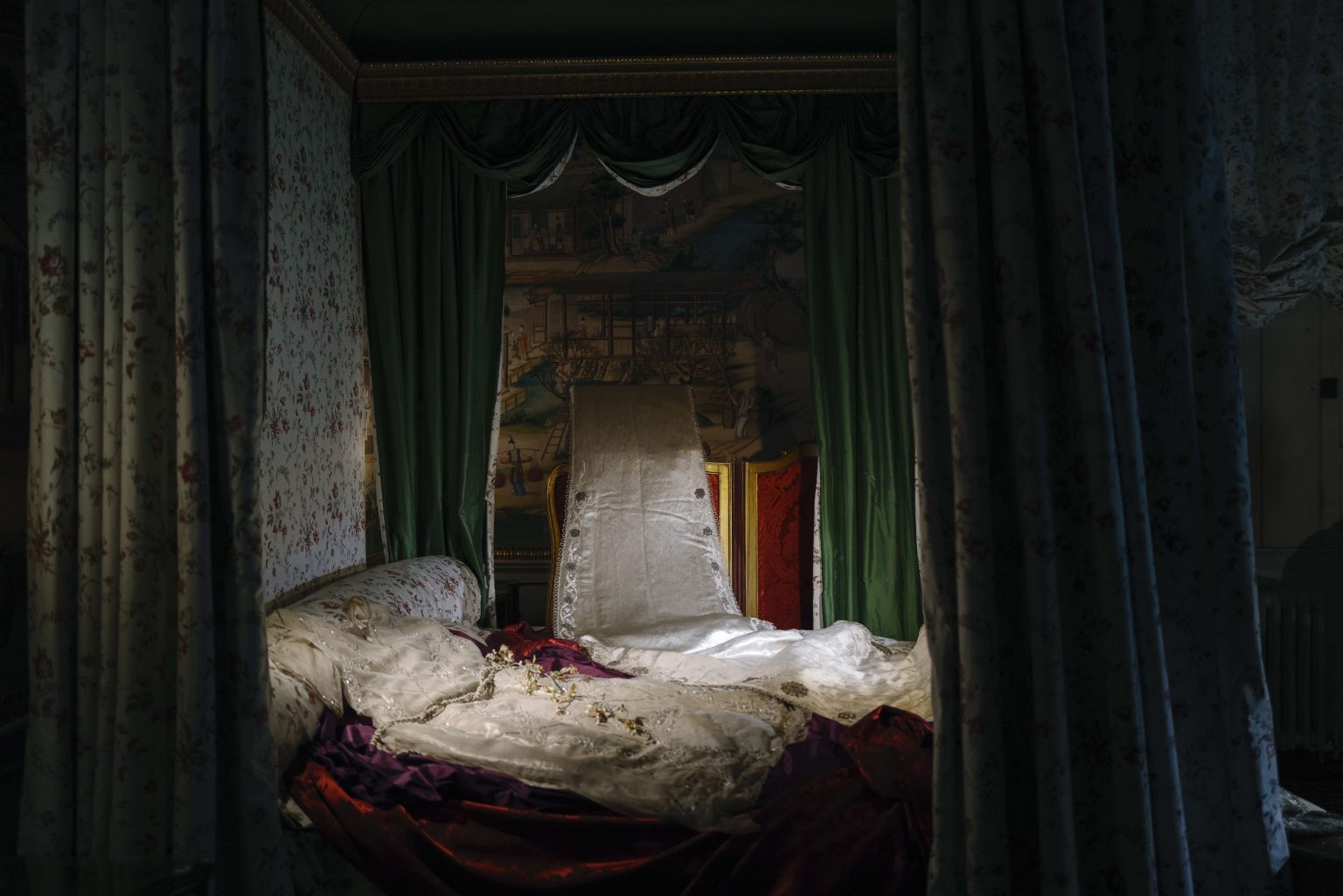
“The archives must never be a dead place, a worshipping of the past.” Joan Nestle
As the queer theorist Ann Cvetkovich tells us: “gay and lesbian cultures […] have had to struggle to preserve their histories. […] Forged around sexuality and intimacy, and hence forms of privacy and invisibility that are both chosen and enforced, gay and lesbian cultures often leave ephemeral and unusual traces”. Queer lives have often been unrecognised by institutional records and by the normative cultural politics of prestige that govern who does, and doesn’t ‘deserve’ a public archive. French philosopher Jacques Derrida reminds us that the word ‘archive’ comes “from the Greek arkheion”:
“initially a house, a domicile, an address, the residence of the superior magistrates, the archons, those who commanded. […] On account of their publicly recognized authority, it is at their home, in that place which is their house (private house, family house, or employee’s house), that official documents are filed.” Jacques Derrida, Archive Fever, 1996
If queer lives have often been unofficial lives: lived outside of the law, outside of documentation, kicked out of the family house, forced to make our own homes; then one such home has been made in a new exhibition currently at BACKLIT in Nottingham. BACKLIT is the latest venue to host the work; launched at Devonshire Collective in Eastbourne in July, and subsequently travelling to galleries in Brighton and Portsmouth from here. Tessa Boffin: Where We Touch the Archive is itself a capacious example of queer kinship: co-curated by Polly Wright (curator at the Devonshire Collective), Jazz Singh Swali (curator at BACKLIT gallery), Ricardo Reverón Blanco (independent curator) and Daniet Ariel (curator at Photoworks), and the majority of the works comprise responses to Boffin’s archives of other artists, as well as a living archive of documentation of queer lives from around the world.
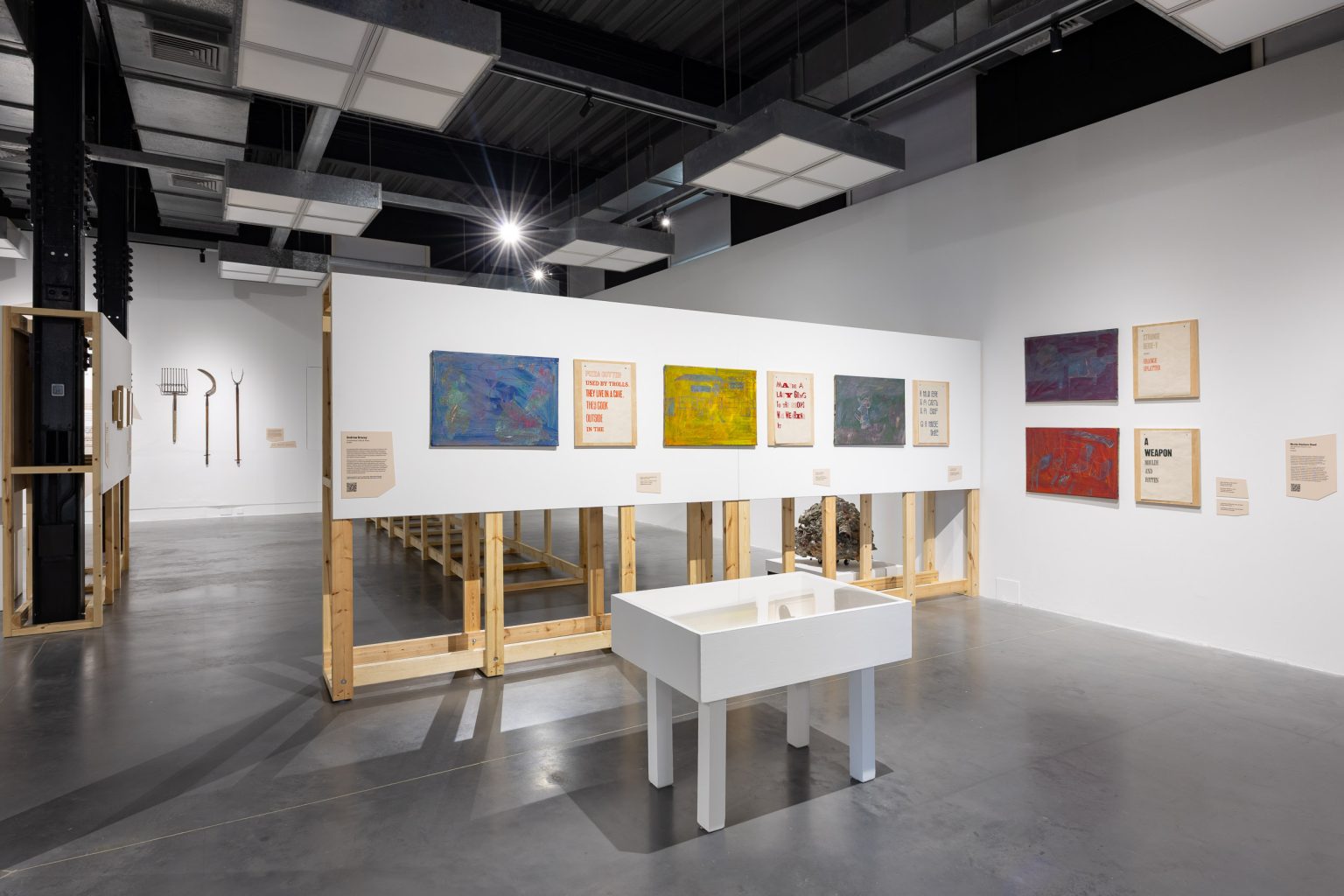
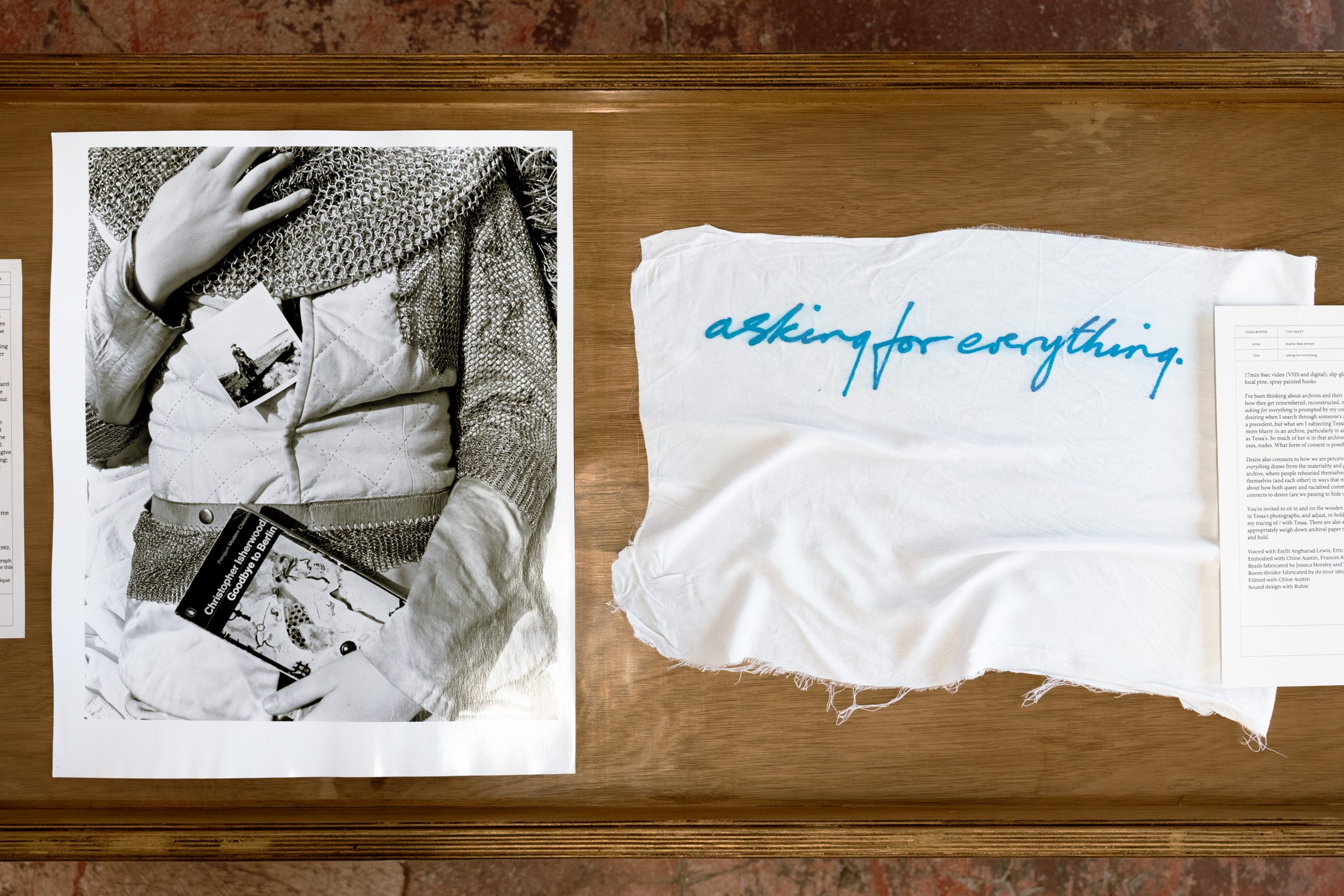
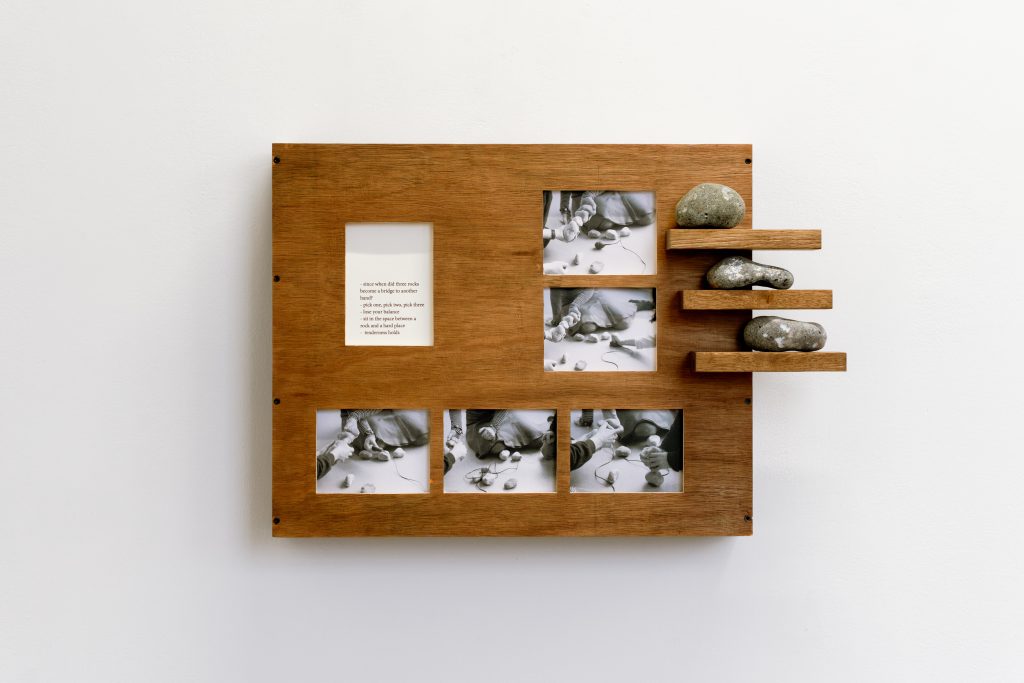
The exhibition troubles the notions of what an archive is, who gets to have one, what we do with archives and what archives do with us. As the title and catalogue image, a hand reaching out to touch an arm, suggest, Boffin’s sensibility is haptic. Fragments of queer lives are layered as sheets in boxes for us to rifle through in the gallery, as THE DRAFT (2026). Pebbles are stacked on the edge of a wooden frame, as part of do step on each other’s toes (2026), an assemblage piece devised and developed with artists Eva Louisa Jonas and Kairo Urovi, together with young people in Eastbourne. We’re invited to hold these rocks in our palms. And all of it is presided over, in absentia, by Tessa Boffin: artist, activist, trickster and legendary lesbian.
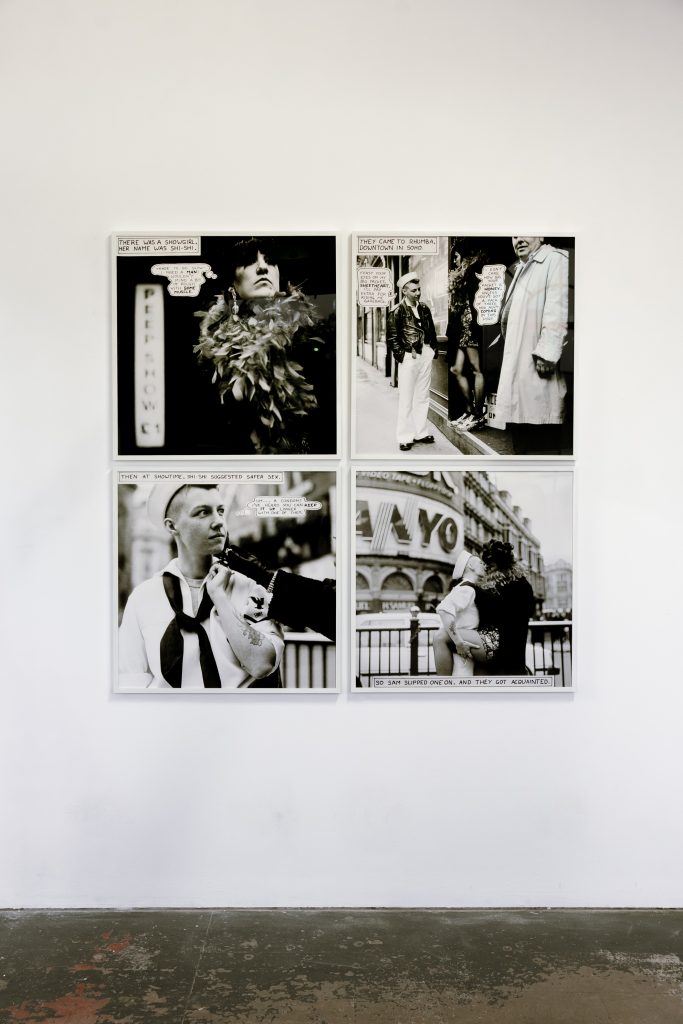
If you come to this exhibition hoping to get a glimpse of the ‘real’ Tessa Boffin, a peek into her private effects, or the final word on her creative process, you won’t get it. Two works show Boffin in a kind of drag. In The Sailor and the Showgirl, 1993/2023, Boffin is in double drag: the first layer as a femme, the second as a femme that has gone so heavy on the make-up that she appears herself to be a drag queen. Four images, laid out and scripted in a comic book style. Boffin plays the role of showgirl ‘Shi-Shi’ looking for love, or a little loving, in Soho. In the images she is propositioned by a sailor (played by Nerina Ferguson, Boffin’s real-life girlfriend). Shi-Shi suggests that they practice safer sex. The last frame in the story shows the pair in a passionate embrace, the old Piccadilly Circus Sanyo sign in the background.
‘The King’s Trial’ (1991), features Nerina Ferguson, Boffin’s girlfriend, in tough-guy/girl mode, hand on hip and eyes down the camera. Above her image is the caption: “This is a woman. She is dressed as a man because…” .Four tick-boxes, running the length of Boffin’s body suggest answers to this question as if this is some kind of GCSE gender studies exam. The possible answers range from: “a) She wanted to seduce other girls” to “d) She is a gender bending drag king.” Intended for display in public as part of a billboard display, Boffin made the piece in response to a court case where a woman, Jennifer Saunders, was convicted and later released for the rape of two teenage girls whilst dressed as a man.
Both works by Boffin, positioned on the edge of the exhibition space, act as tongue-in-cheek ‘Door Butches’ to the exultant queer gathering happening in BACKLIT’S main warehouse gallery space. Where We Touch the Archive is a heartwarming and gorgeous iteration of the common queer practice of the chosen family, and the desire for it. This family embraces Boffin, who died in 1993, and whose work is less of a contextual frame for the exhibition than a pair of loving arms, open and extended in welcome to other artists who all form part of her archive. In the bricolage of this curatorial vision, the exhibition links hands with LGBTQIA+ strangers around the world, inviting them to share their own lives as part of a growing paper assemblage called ‘THE DRAFT’ (2026) – boxes of A4 sheets of reflections, personal narratives, photographs, and other ephemera, contributed by the public which will ultimately be gathered into a publication. BACKLIT’s curator, Jazz Singh Swali, told me that each time they walk into the gallery space, “the boxes have been moved and the pages have been shuffled.” Again, there’s an irreverence here, and throughout the exhibition that stands in joyous contrast to the typically staid, reverential and precious vibes of the archive.
Many of the photographic works on display depict friends and lovers in glorious tangles, or balancing acts – as with ‘do step on each other’s toes’ (Eva Louisa Jonas and Kairo Urovi, 2026), developed through a workshop with young LGBTQIA+ people, where “participants negotiate acts of balancing, holding, following and falling that can only unfold in relation to others.” Meanwhile, Leah Mclaine’s portraits show queer characters held still in one moment but gazing into a future that has yet to materialise. In the exhibition catalogue Mclaine describes these images as “a practice of projecting yourself into a form of being as sustenance for the now.”. I found these to be some of the most moving images of queer kinship, in an exhibition full of them. Mclaine’s work serves as a crucial element in the exhibition’s disruption to normative notions of the archive. Here, the disruption is to the misconception that the archive is composed of things and people only from the past. In their orientation towards Boffin’s archive, Mclaine, instead, almost construes it as a message from the future, sent back from one who has walked ahead: “I could not help but read the archive through this lens of throwing things at the wall to see what sticks, to see a way forward, even if tragically, Boffin never got to be there in the end.”
‘ask for everything’ (2026), a film by Sophie Mak-Schram, gestures to the relationship between the archive and consent, and to the fantasy (skewered by the work itself), that an archive will give us “everything” of an artist. I step into a darkened room, a large projection looping at the front, a series of ad-hoc looking structures dotted around in the background which the viewer is invited to sit on. These structures, Mak-Schram tells us, are “based loosely on structures visible in Tessa’s photographs.” Again, there’s a loving incorporation of Boffin’s archive and life into the work on show and a resistance to the notion of the archive as a series of fixed and finished objects that live in the past. Already, the reverence and rules that govern the conventional entrance to a (conventional) archive are disrupted here: there will be no putting on of protective gloves, or locking away of one’s own personal effects before encountering someone else’s. Instead, there is a choice as to how to position one’s self in relation to the material that Mak-Schram has gathered. Will we be totally immersed? Or keep ourselves at a distance?
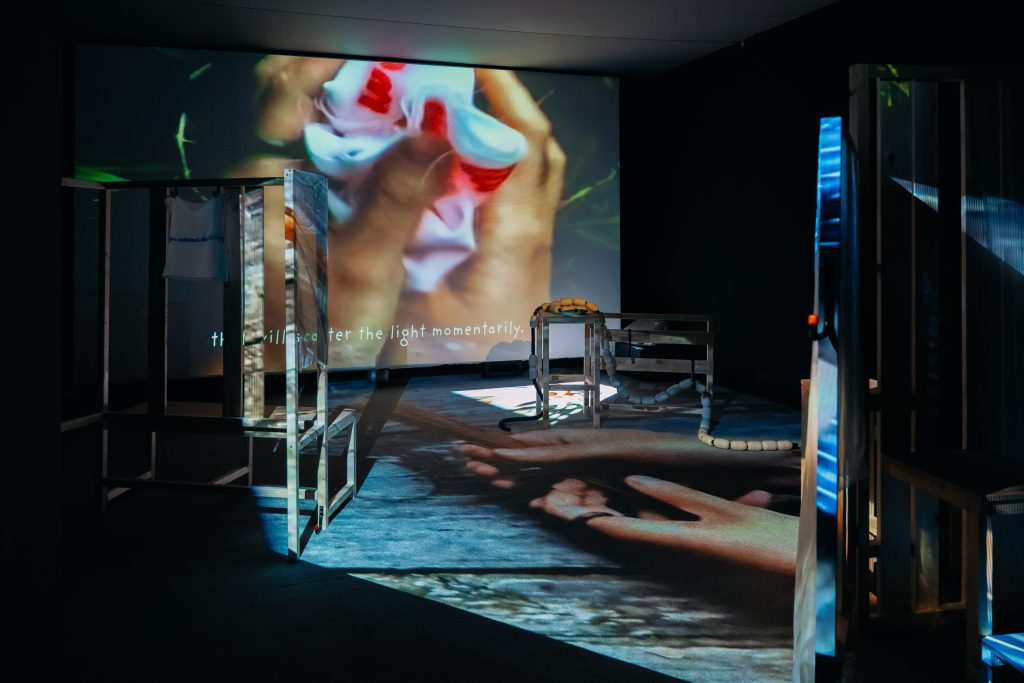
We don’t ever get to touch Tessa Boffin’s archive in this exhibition–or at least not in the ways we might expect from past experiences. There is no entering hushed spaces after putting our belongings in the locker. There is no reverent fingering of dusty papers, or leafing through old photographs. There definitely isn’t any of the will to extract that I would associate with my archival experiences of yore (where ‘yore’ = my previous life as an academic). Then, archival visits were characterised by a sometimes frenzied hunt through manila folders and crammed boxes for ‘the thing’: that letter, diary entry, or manuscript that would answer, once and for all, a looming research question, or that would provide me with a ‘unique contribution’ (demanded by institutional learning’ to knowledge.
At BACKLIT the archive is a felt presence and a shaping force rather than a series of communiques from the past to be consumed or repurposed by enquiring hands. In this archive, we’re all part of a chosen family, all shaped by each other. There’s no hierarchy just because of one person’s name on the door. Tessa Boffin: Where We Touch the Archive is an embrace of an exhibition, to experience and to be in: inter-generational, generous, warm and crucially, open to all.
Ruth Charnock is a queer writer, artist and facilitator based in Lincoln.
Tessa Boffin: Where We Touch the Archive, BACKLIT Gallery, Nottingham, 18 September – 17 October 2026. The exhibition will tour to Photoworks in Brighton, then on to Aspex in Portsmouth from 2nd December until 28th February, 2027.
This review is supported by BACKLIT Gallery and Devonshire Collective.
Published 21.10.2026 by Rachel Graves in Features
1,684 words