I remember the first time I laid eyes on a work by Linder. Fourteen, maybe fifteen years old, in my high school’s aggressively navy blue and slightly stale-smelling computer suite, researching ideas for my Art GCSE final project. Flicking through search terms like ‘collage’, ‘women’, ‘body image’, until my eyes landed on a woman in a man’s embrace, holding a large fork turned inwards, jamming the prongs into her garish, buggish eyes. I learn the piece is simply named ‘Untitled’(1976) which makes sense – Linder’s works often speak for themselves.
The combination of tongue-in-cheek humour, biting commentary on gender politics, and razor-sharp precision in deftly interweaving layers of cutout images made me fall in love with Linder’s photomontages, and I play this revelatory moment over in my mind as I travel to the Grundy to see Linder: The Return of Linderland.
This exhibition is Linder’s first solo show in the North West in twenty years; something of a homecoming for the Lancashire-raised artist.
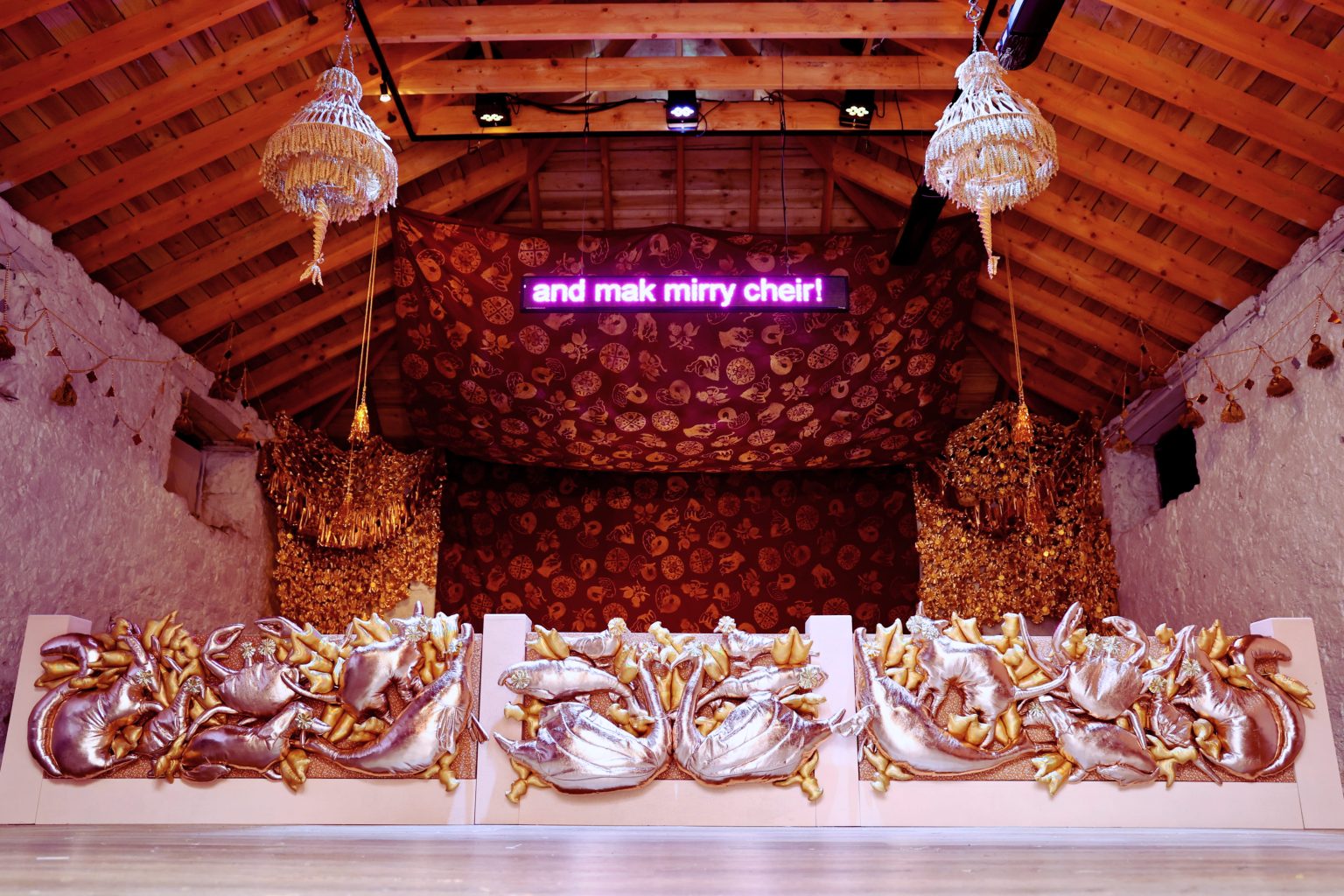
The exhibition is a new iteration of the 2025 show, Danger Came Smiling, which following its run at the Hayward early last year, toured first to Inverleith House Gallery in Edinburgh’s Royal Botanic Garden, then to the Glynn Vivian Gallery in Swansea. Whilst Paulette Brien, Curator at the Grundy, tells me that ‘there was always going to be different iterations’ of the show, its Blackpool iteration feels bespoke; more personal, somehow.
After all, it’s been given an entirely new name – one that directly references Linder’s last North West major solo show, The Return of Linderland at Manchester’s former gallery the Cornerhouse in 2000. As I wander the foyer, gathering my first impressions, I can hear a visitor excitedly regaling staff on the front desk with their memories of the original Cornerhouse show – and particularly how nice it is that these works are being shown ‘up here’ once more. This is just one anecdote of how a sense of place and belonging to a place provides a significant reference point within the curatorial narrative.
This sense of place is imprinted upon me almost immediately within the show’s spatial layout. As I look directly from the foyer’s vestibule into the long hall of adjoining Galleries One and Two, my view is framed by two large, vibrant and almost iconographic wallpapers resembling billboards, pasted onto the gallery walls.
The wallpapers were co-devised between Linder and media company BUILDHOLLYWOOD, who are notable for their wide array of billboard campaigns with clients ranging from ad agencies to art charities – and manufactured the works in-kind.
They project an intoxicating tempest of collaged images, such as instantly recognisable Linder works like the 1977 cover for the Buzzcocks’ ‘Orgasm Addict’ EP – which also makes a modified appearance in this exhibition as a backlit Duratrans entitled ‘It’s the Buzz, Cock!’ (2015). Such imagery is mixed in with contemporary perfume adverts, shiny metal and marble furniture, jewels, rid lips, flowers – even a cheeky seagull in reference to the show’s seaside location.
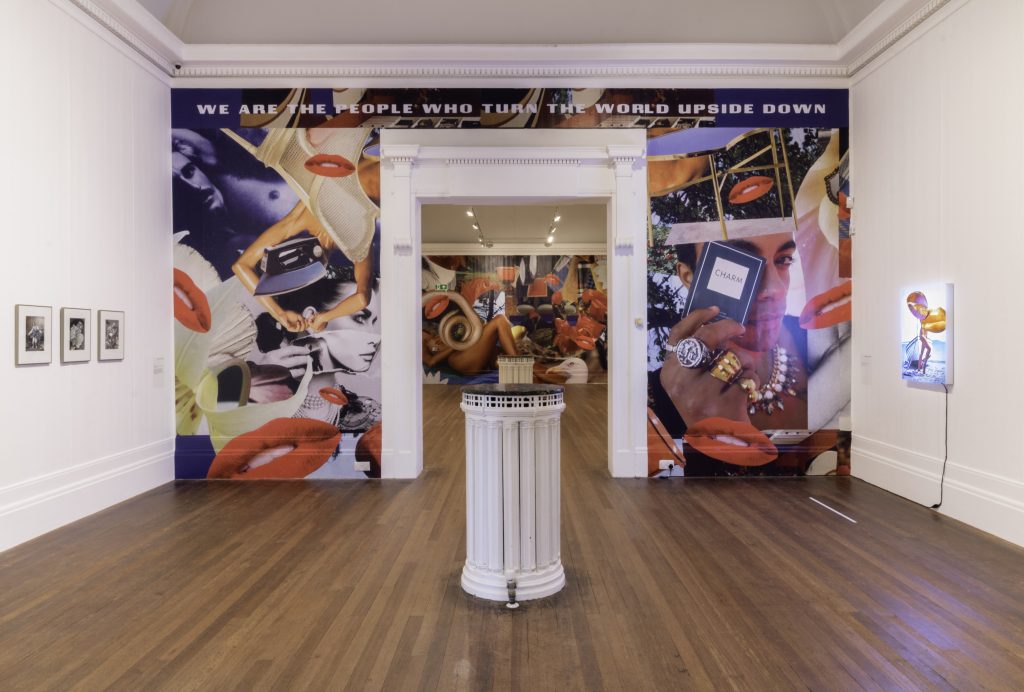
On the surface, it’s dazzling, fun, inviting your eye to wander. Look deeper, and the layers of imagery speak to those ever-present themes of Linder’s work; of gender, consumption, bodies, and nature. This culminates in the sprawling exhibition landscape that is ‘Linderland’ – a physical and spatial manifestation of themes Linder has tackled over the past fifty years. The use of the billboard-style wallpaper beckons you to step into this world in a literal sense.
The lore of this landscape unfurls further when considering the title of the wallpapers, ‘We Are the People Who Turn the World Upside Down’. The work’s accompanying text makes clear that this title is a quote famously attributed to Lancashire woman and founder of the eighteenth-to-nineteenth century Shaker movement, Ann Lee.
The use of this provocative and challenging quote conjures a questioning of norms, an upending of order which ultimately reflects tenets of Shakerism that were, for their time, controversial: the rejection of patriarchal hierarchies, oppression and repression, and an all-consuming use of art and music as transcendental and sacred.
By introducing the exhibition’s audience to Ann Lee and the Shaker Movement so centrally, Linder both cements the mythology of ‘Linderland’ as something grounded in place and her roots in Lancashire, and positions herself with Lee, as Lancastrian feminists who believe in the power of art to move society.
Like place, Linder’s understanding of art as a societal tool is central to the exhibition. Alongside the exhibition’s opening text in the foyer gallery, a monitor shows Linder in conversation with Art Review’s Fi Churchman in early 2025, a ‘studio spotlight’ recorded by the Southbank to promote Danger Came Smiling. Here, Linder says, ‘by the time I’m seventy I thought we’d be living in peace, but I think we’re further from it’. Similarly, in the same video she explains that, often, she feels that each photomontage she creates is ‘…evidence, to say, “yes, life really, it really was like that”’.
It is this documentary lens and its use in exploring contemporary society that makes Linder’s work, particularly her photomontages, so magnetic. Each work is a carefully crafted statement which speaks to a specific point in time. Bringing works together in a retrospective like this, then, amplifies that Linder’s artistic voice is not simply confined to the 70s scene in which she cut her teeth. Rather, Linder seems to have her finger – or her scissors – on the pulse of contemporary conversations around gender and body politics. Her explorations of these themes continue to feel apt, particularly in their intersectionality. Whilst it’s no secret that the second-wave feminism of the 70s tends to obscure conversations around marginalisation by focusing on the universal female experience, Linder’s politics are overt and cogent.
This is especially evident in Gallery Two, which largely concerns itself with representations of the female body. On one wall is a trio of photomontages, ‘In The Bardo II, III, IV’(2025). These photomontages take early publicity photographs of French actress, Brigitte Bardot, and overlay them with porcelain figurines taken from collections catalogues. ‘In The Bardo II’, for example, takes a portrait of Bardot, obscures her face, and places over it a male mythological figure perched on a winged animal.
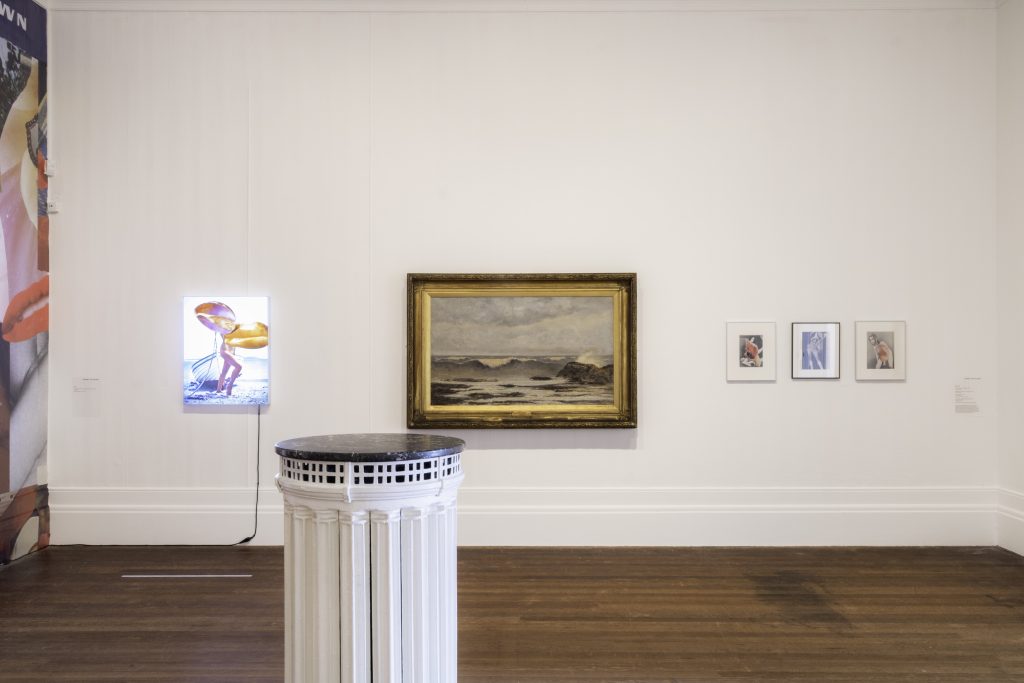
The combination of the monotone press shot and dainty porcelain figure seems to work twofold. Firstly, it interrogates how Bardot’s youthfulness, beauty, and oft remarked upon style cemented her in the French, and later global, imagination as a reified pin-up and icon, an objectified and unattainable beauty. Secondly, by drawing on the symbolism of porcelain and its materiality, as cold, hard, brittle, white, Linder explores how Bardot — who had a sustained and troubled history of racism, homophobia, xenophobia and misogyny — comes to represent what Linder terms, according to the piece’s exhibition text, a ‘politically calcified’ worldview.
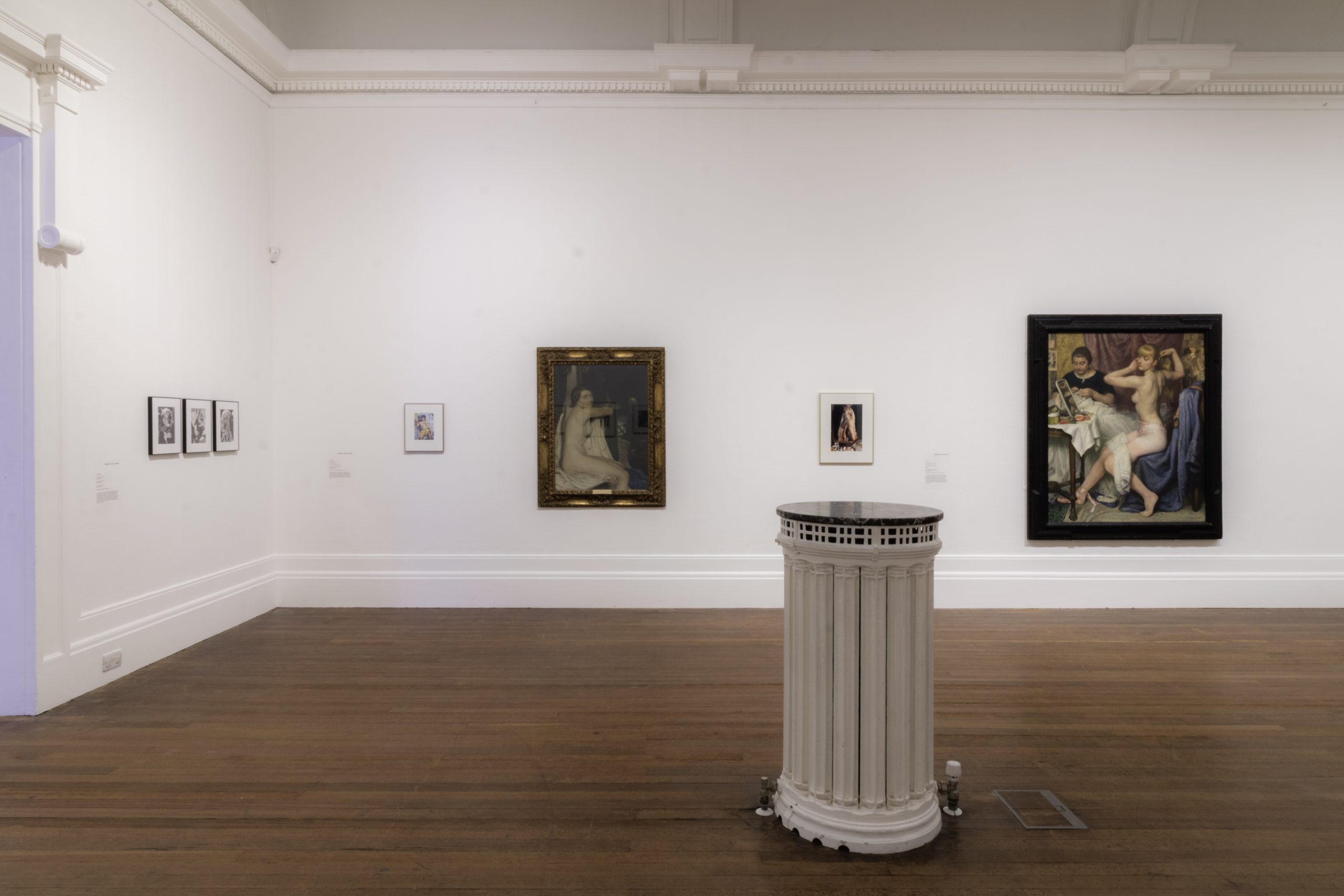
Throughout the exhibition, Linder has selected works from the Grundy’s collection to stand in conversation with her own. The photomontage showing sex worker and activist Mia Khalifa styled as Mary Magdalene, entitled ‘Did he prefer her to us?’ (2023), is brought into conversation with oil painting ‘No. 1 Dressing Room’ (c.1940s) by Laura Knight.
In the former, Khalifa gently crosses her arms, looking away from the camera, her tresses of blonde hair topped with a crown and a single snake. Part of a gilded frame seems to hem her in, as the periphery of the image shows a beady-eyed bird and what appear to be butterfly wings. In the latter, an unnamed performer sits topless, arms outstretched towards her head as she looks into a mirror and fixes her hair, poised and focused. She is accompanied by another woman, who looks downwards mending a large, white skirt.
In both images, neither subject looks directly at us, the viewer. Instead, both are engrossed in their respective actions, subjecting the viewer to the discomfort of complicity and voyeurism. It’s a curious statement on performed femininity and the gaze, especially when one shifts perspective to look at both works beside each other. Following the performer’s gaze in ‘No.1 Dressing Room’, she almost looks directly onto Khalifa, encouraging us to think about the changing role of gendered performance within the nearly-hundred years that exist between the two works. Arguably, it prompts a conversation about the feelings of guilt and shame inherent to female expressions of sexuality, and reclamation of agency – especially in the context of sex work.
Linder’s selection of works for this exhibition feel natural and skilful, perhaps because her artistic influences are so wide-ranging. This is exemplified in the final gallery, which brings together works by L.S. Lowry loaned from the Lowry, anatomical plant models made by Berlin firm R. Brendel & Co, loaned from Gallery Oldham, and earlier Linder works – from drawings from her student days to vitrines of material used in the original Return to Linderland show at the Cornerhouse.
Arguably, this gallery is the most intimate, it’s where Linder’s voice can be felt the most – artistically, curatorially, politically – and personally. Linder’s voice is quite literally front and centre across the wall text she has written on Lowry’s mannequin drawings, and inevitably there’s humour in Linder telling the audience that Mark E. Smith once told her that Lowry was nothing more than ‘a fucking rent collector’, and a humanity in telling us of her love for Friday ‘brokes’ (broken biscuits) brought home by her mum from her factory workplace. Moreover, though, the selection of objects across the room feels like the beating heart of what the landscape of ‘Linderland’comes to symbolise across place and time – exploration, curiosity, gender, queerness.
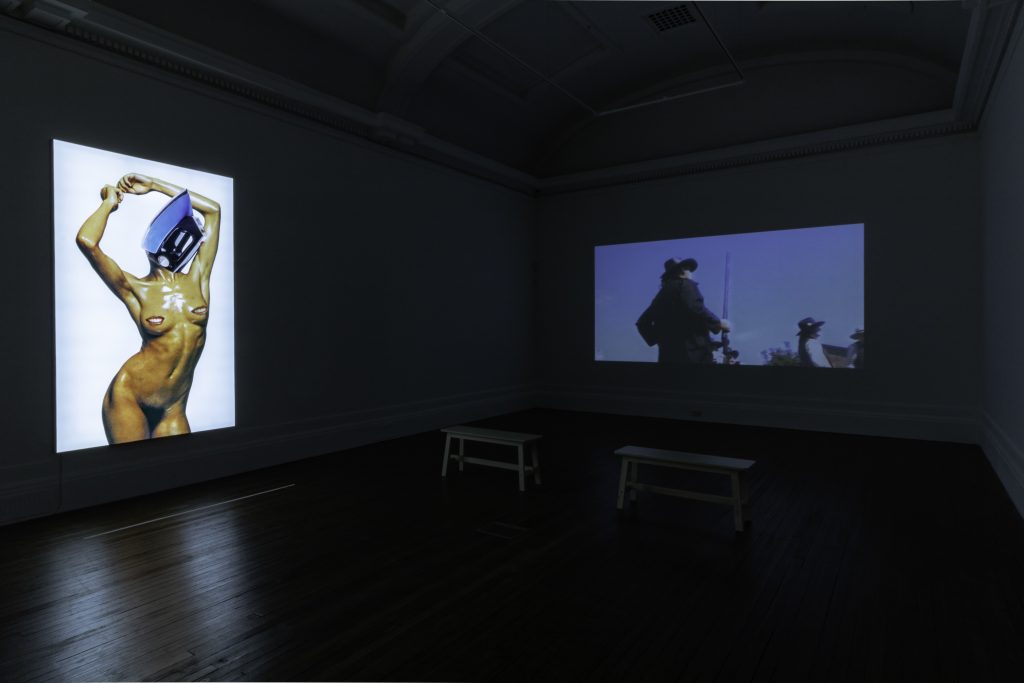
This stands out across three key domains: the vitrines of the Cornerhouse exhibition, a series of photomontages presenting queer male identity and masculinity, and Linder’s three ‘Untitled’drawings, made in 1977 when Linder was a student of the then Manchester Polytechnic (now MMU).
The latter, a series of sketches showing naked women reclining and/or masturbating, demonstrates Linder’s interest – early in her artistic exploration – in the politics of female pleasure and the way it is packaged and mass-produced for, often male, consumption. There is a simplicity to the drawings that feel novel and intimate, perhaps because they’re markedly different to the layered photomontages for which Linder is most known.
The photomontages of men are striking. Take ‘Head to Head’ (2017), a gloriously colourful work centring American singer Johnnie Ray, early proponent of rock and roll, whose sexual fluidity and playfulness was a hallmark of his live performances. ‘Head to Head’carries forth this playfulness with bright colours and innuendo aplenty; a softly unfurling pink rose placed at the crotch of a naked male cover star of a pornographic magazine. The frequent references to the natural world present as both visually compelling and deliberate; scientifically and naturally speaking, queerness is inherent to many other living beings. It is not unnatural.
The vitrines, however, are my favourite part. They perfectly round off and bring together this exhibition in the context of its Cornerhouse predecessor, containing objects and ephemera from that original 2000 show. The exhibition’s concept came from Linder’s discovery of the L.I.N.D.A Club, a society existing for everyone named ‘Linda’, who first convened in 1987 in Cedar Rapids, Iowa. Linder began to explore what her personal version of this could look like. The vitrines contain all manner of ephemera, including prints heralding ‘the working class goes to paradise’, an embossed metal plate, small cowboy figurines, and a beard worn by Linder as she performed both as a Clint Eastwood-esque Western character and Ann Lee at a four-hour performance in North Manchester.
These cases feel as though I’m being invited to sit down with Linder and receive a glimpse into her world or, rather, her land. One photograph in particular draws me in. Sandwiched between two dog tags, one emblazoned with ‘LINDERLAND’, the other with ‘ESTATE AGENT’, is a small girl, hair pulled back into a bun, hugging a woman in dazzling costume, adorned with makeup and sparkles.
It’s unclear who the pair are, but I like to think that the young girl is Linder. Perhaps the figure is her mother, or a family friend, or maybe I’m way off base. Even if I am, I like to think that I have such an affinity for this picture because of what it suggests ‘Linderland’is to me; a place for young girls to be embraced by their elders, to be fascinated by their flamboyance, and to be curious about their performance.
There’s something inherently relational about the picture that ends the exhibition on a touching note. It makes me wonder where that curiosity, or awareness of my gender, was sparked for me when I was that young. Perhaps it was when I was in that aggressively navy, stale-smelling computer room, seeing Linder for the first time. I wonder if this exhibition will awaken others similarly.
Linder: The Return of Linderland, Grundy Art Gallery, Blackpool, 18 July – 3 October 2026.
Amie Kirby is a writer, researcher, producer, and community organiser based in Salford.
This review is supported by the Grundy.
Published 25.09.2026 by Jazmine Linklater in Reviews
2,259 words