A rhizome is a plant structure that grows both underground (roots) and overground (shoots). The word comes from the Greek rhizoma, meaning root. In 1972 Deleuze and Guattari borrowed this word to describe a postmodern process of existence and growth through a non-hierarchical system of networks. The rhizome is a decentralized network that has no centre point or origin. It is not linear; instead, it creates a web, multiplying outwards organically. Rhizome has since become somewhat of a trendy reference in artist texts, graduate dissertations and exhibition press releases. Apprehensively ascending the flight of stairs at Bankley Gallery, I wondered if rhizome here might be something of a get out clause – a concept so flexible it could wrap around any exhibition.
The exhibition was conceived by independent Manchester-based curator Sotoodeh Horriat. Horriat brought together work by London-based Anali Taherian and Manchester based artists Anita Memar, Fateme Yousefian and Mahrokh Mofid Nakhaei, all of whom are originally from Iran and currently based in the UK having pursued graduate study.
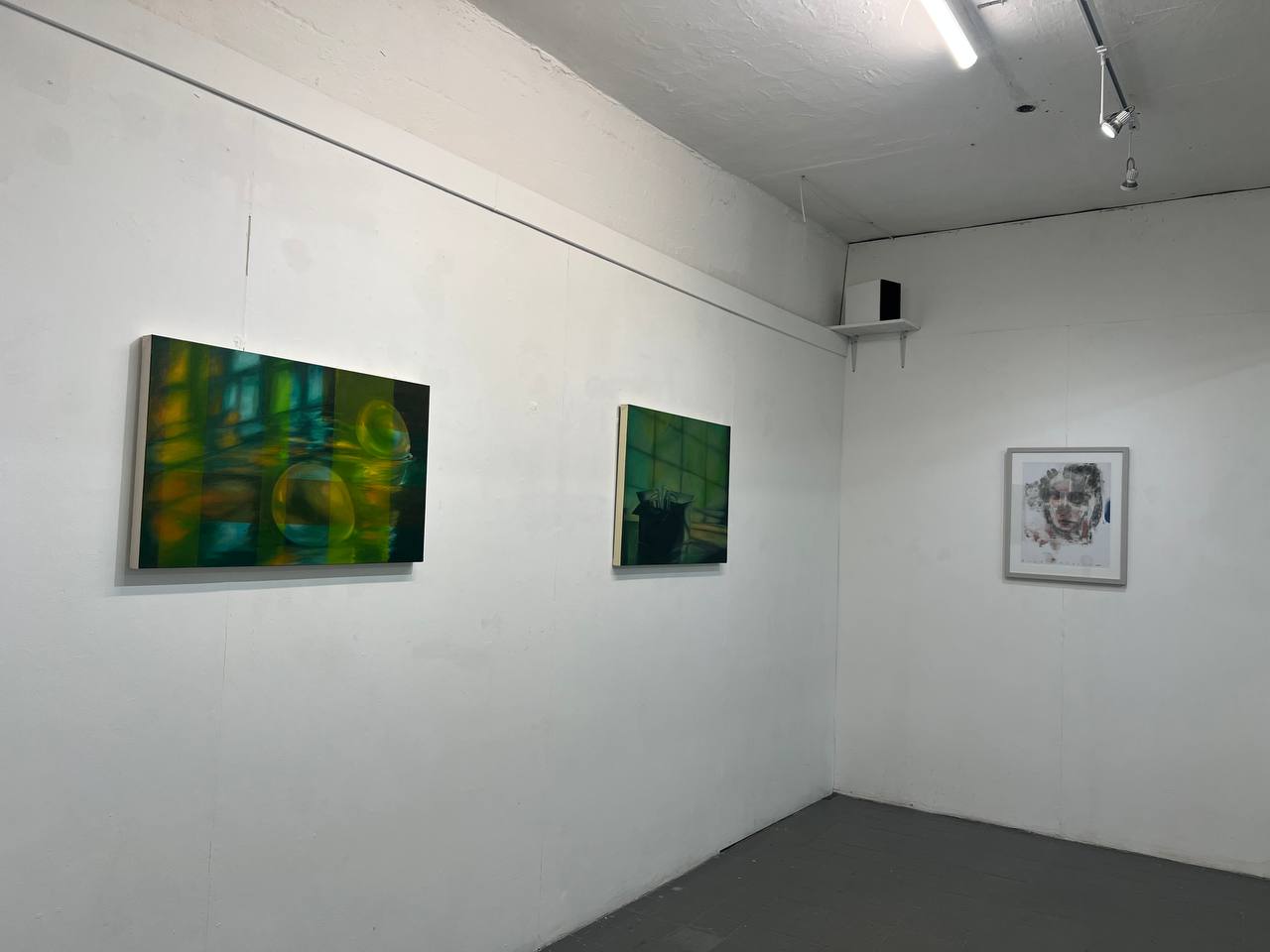
Anali Taherian presents a series of fragmented, blurred, mixed-media portraits. Anita Memar also turns to portraiture but taking a more surreal approach. Fateme Yousefian works across sculpture, illustration and animation. In this exhibition she presents a series of small-scale, exaggerated figurative sculptures. Mahrokh Mofid Nakhaei, who is part of Apollo Painting School’s Cohort 2, presents a series of contemplative paintings of empty, dark spaces and fallen balloons. Each artist presents intriguing offerings to the audience that, at first glance, appear disconnected from each other.
Interviewing the artists as I walk through the space, however, opens up connections. I begin my interview with Sotoodeh Horriat on how she brought such divergent artists together. She explains to me that ‘rhizome gave me a way to think about these differences without trying to resolve them into one common narrative’. She notes that she is less ‘interested in making the four practices look similar, not removing differences, but questioning the boundaries that make things appear completely separate from one another’.
I wonder if, for Horriat, rhizome is less a concept to be applied to the artists’ work but instead a reflection of her own sensitive curatorial practice. She tells me: ‘My role is more about creating conditions in which another layer of meaning can emerge’, as is evident in the division of the gallery. Instead of four distinct spaces she carefully overlaps the artists. For Horriat this ‘helped soften the boundaries between the individual practices’. She envisions an exhibition as ‘having two levels’, explaining: ‘You can encounter a work individually and understand it through the artist’s own practice, but when you step back, that same work begins to communicate differently because of what is beside it, opposite it, or even physically distant from it. The curatorial meaning exists in that second layer. It doesn’t replace the first one; it grows alongside it.’
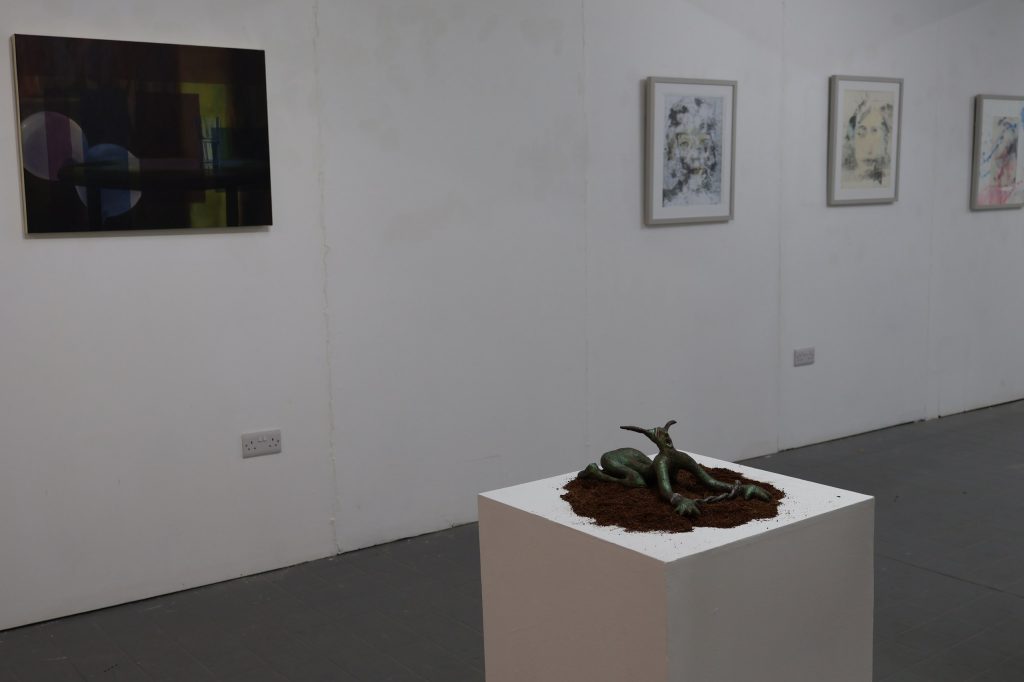
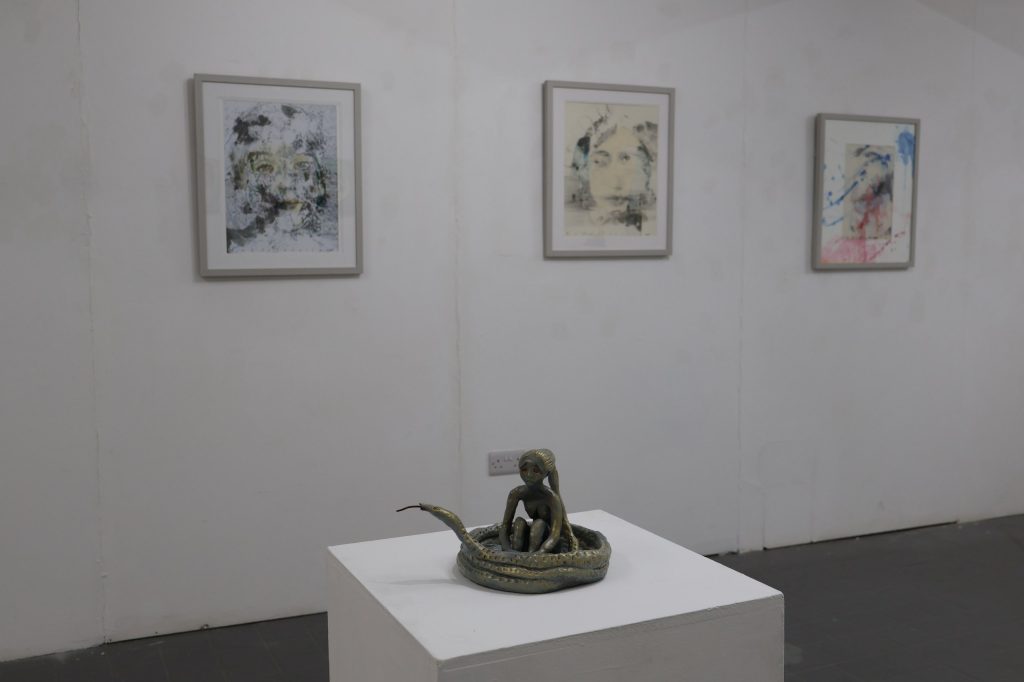
This second layer rears its head in an interesting dialogue between works by Anali Taherian and Anita Memar. Placed on opposing walls, Taherian’s portraits – mixed media combining drawing and painting – stare at Memar’s vibrant acrylic paintings adorned with air dry clay. Anali’s portraits are washed in grey, sparse pops of magenta, yellow and cyan blue – as if the portraits were photocopied and printer cartridge ink had spurted out. The portraits are disrupted, figures dissolved, distorted and even effaced. Taherian unsurprisingly cites Francis Bacon as one of her influences. She tells me she has always been ‘fascinated by the way the face moves beyond simple representation. The form becomes distorted… it is precisely through this breakdown that another kind of human presence emerges. This feels very close to the way I experience portraiture in my own practice. ‘For me, the face is less a means of identifying a particular person and more a space where representation begins to break down, allowing presence and intensity to emerge beyond identity.’
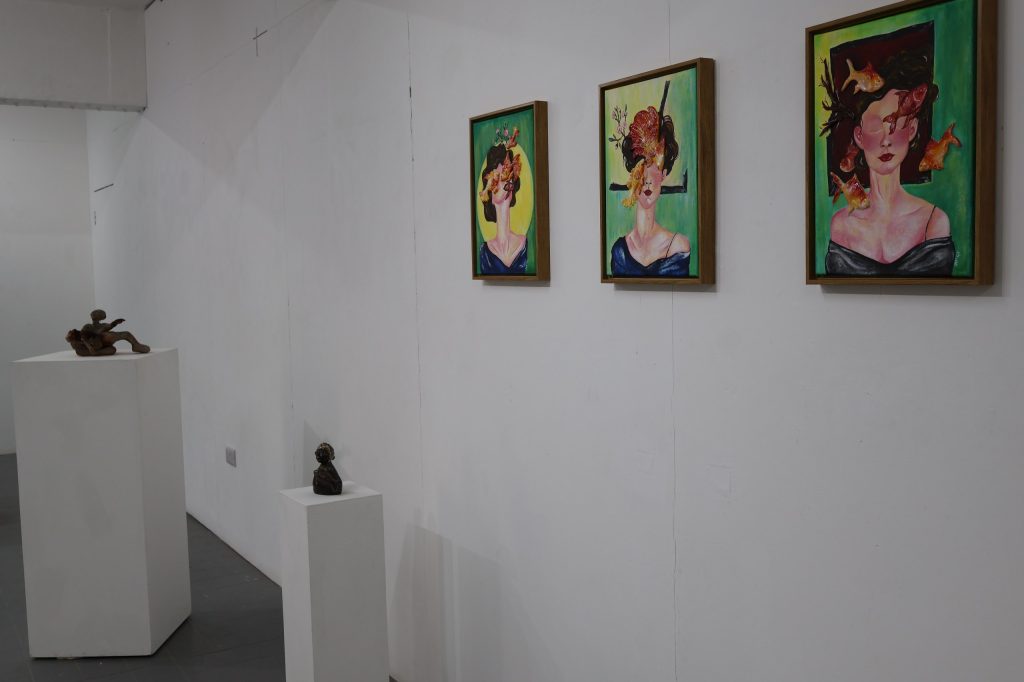
As I cross over to Memar’s paintings I notice their composition. They resemble the composition of Frida Kahlo’s self-portraits, an almost head-shot-like close crop with surreal qualities. The figure’s face in Memar’s paintings is often partially concealed by fiery floating fish, orange scales glistening. I ask her about her artistic influences, expecting to hear Kahlo named. Instead of visual artists, she refers to the Sufi mystic poets: ‘My practice is influenced by storytelling, memory, lived experience and poetry. I am particularly drawn to Rumi and his ideas around inner transformation, looking beyond the visible and finding a quieter space within ourselves.’
Memar goes on to tell me about the significance of fish in her visual language. She explains that, ‘for me, it represents the possibility of finding that same calm within ourselves. The covered eyes connect to this turning inward, away from external noise and towards an internal space. Over time, the fish has become a metaphor for peace gradually filling our entire being, as if we are immersed in water and moving freely within it.’
Memar also creates sculptures. Ceramic allows her to explore these emotional worlds using the ‘unpredictability’ of clay, which she explains has ‘weight, volume and texture, but it also records touch, pressure and movement’. She enjoys the ‘need to respond to the material rather than completely control it’, a comment reminiscent of Taherian’s. Taherian dwells in the spontaneity of her medium. She is looking for ‘the moment when the image is no longer simply following what is in front of me and the painting begins to develop its own logic. At that point, I am not the only one making decisions; I am also responding to what is happening on the surface. A line, a mark, or a shift in form can redirect the entire painting.’
Incisive marks and lines work to shift Fateme Yousefian’s devastating air-dried clay figures. As I move towards them, placed in the centre of the gallery, she explains to me that she is drawn to the material’s ‘three-dimensionality, the way a figure occupies real space. In that space, the figure stops being simply an image of a body and starts to feel like a presence in its own right, almost like a living being sharing the room with you.’ In ‘Entangled’ (2026), a forlorn female figure sits, holding her knees close to her. Her hair, braided into a single plait, tightly coils around her and, trapped within a fortress of her own hair, the braid eventually transforms into a serpent. These unexpected, surreal moments are what Yousefian calls ‘semi fantastical elements’ that aim to lend emotional depth.
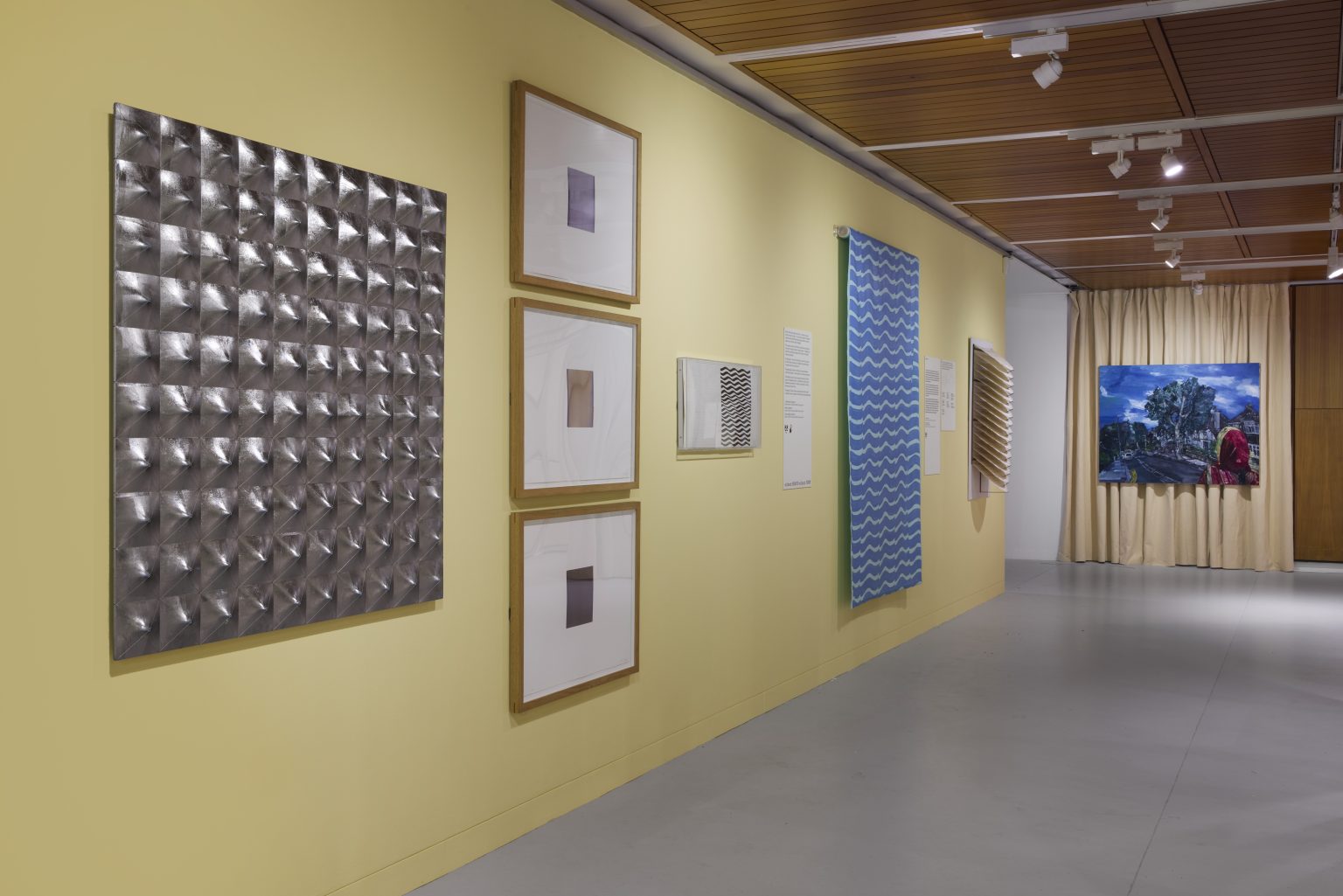
This depth or tension stretches across all four artists’ work. Mahrokh Mofid Nakhaei’s oil paintings shift the exhibition’s focus from human bodies to objects, though she still hints at the same psychological tensions present in the other artists’ work. All three of her paintings centre balloons, though in an unexpected and strange fashion – the balloons sit on the floor, never floating. Nakhaei uses a striking colour palette of blues, greens and yellows to unexpectedly, in her words, ‘shift the atmosphere of the image’. These colours seem as if an urban cityscape is refracted through a window – artificial streetlights flicker, the night sky glows blue.
Nakhaei explains the significance of perspective in her work: ‘I also think about how I can shift what the viewer expects to see by breaking up the space, concealing information, cropping the image, or making something familiar behave in an unexpected way.’ The composition pokes at the artist’s intention to sit with unease and surprise. She explains that: ‘I became interested in balloons because they already carry associations with celebration, but in my paintings they don’t behave as we expect them to. They stay low, on the floor, and sometimes seem almost heavy. For me, they belong to the moment before something happens — a kind of waiting. That waiting gives them a kind of weight: they are ready for celebration, but the celebration has not been allowed to happen. More personally, they have come to carry a shared hope I feel among many Iranian people: the hope that one day we might be able to come together and celebrate freedom.’
Yousefian also turns to the Iranian context in ‘Silence’ (2026) – the most striking of her sculptures – a female figure sitting on the floor with a bloody dead body lying limply in her arms. She stretches her arms wide, mouth wide open. Yousefian explains that ‘the piece was inspired in part by Käthe Kollwitz’s sculpture “Mother with Dead Son”. It responds to death and violence, particularly the mass killing and loss of Iranian lives in my home country, and to the way those lives can become invisible, treated as though they don’t matter. The raised arms form a cry for answers, set against the stillness of the body she holds.’ The invisibility of life and of struggle surges through this work.
After my interviews end, Yousefian’s words persist. Uncovering invisibility feels present not just in her work but across all of the artists. The inner world of Memar’s paintings, Taherian’s distorted portraits, Nakhaei’s sunken balloons and Yousefian’s exaggerated figures all begin uncovering something lying just beneath the surface, ready to be grasped. As I walked back down the winding stairs at Bankley Gallery, I wondered this time if, perhaps, rhizome was more a method through which to move through the exhibition, while a practice of revealing the unseen is what sits at the core of this exhibition.
Rhizome: Memar, Nakhaei, Taherian, Yousefian, Bankley Gallery, 14-21 August 2026.
Vaishna Surjid is a writer and curator based in Manchester.
This review is supported by Bankley Gallery and Studios.
Published 16.10.2026 by Jazmine Linklater in Interviews
1,647 words