To tend to something is an act of devotion, it’s also a responsibility. To tend is to cultivate and to honour, to be a steward of something beyond yourself. From speaking with the artists of De Montfort University’s MA Contemporary Art Practice course, it is clear that this ethos extends across the Degree Show.
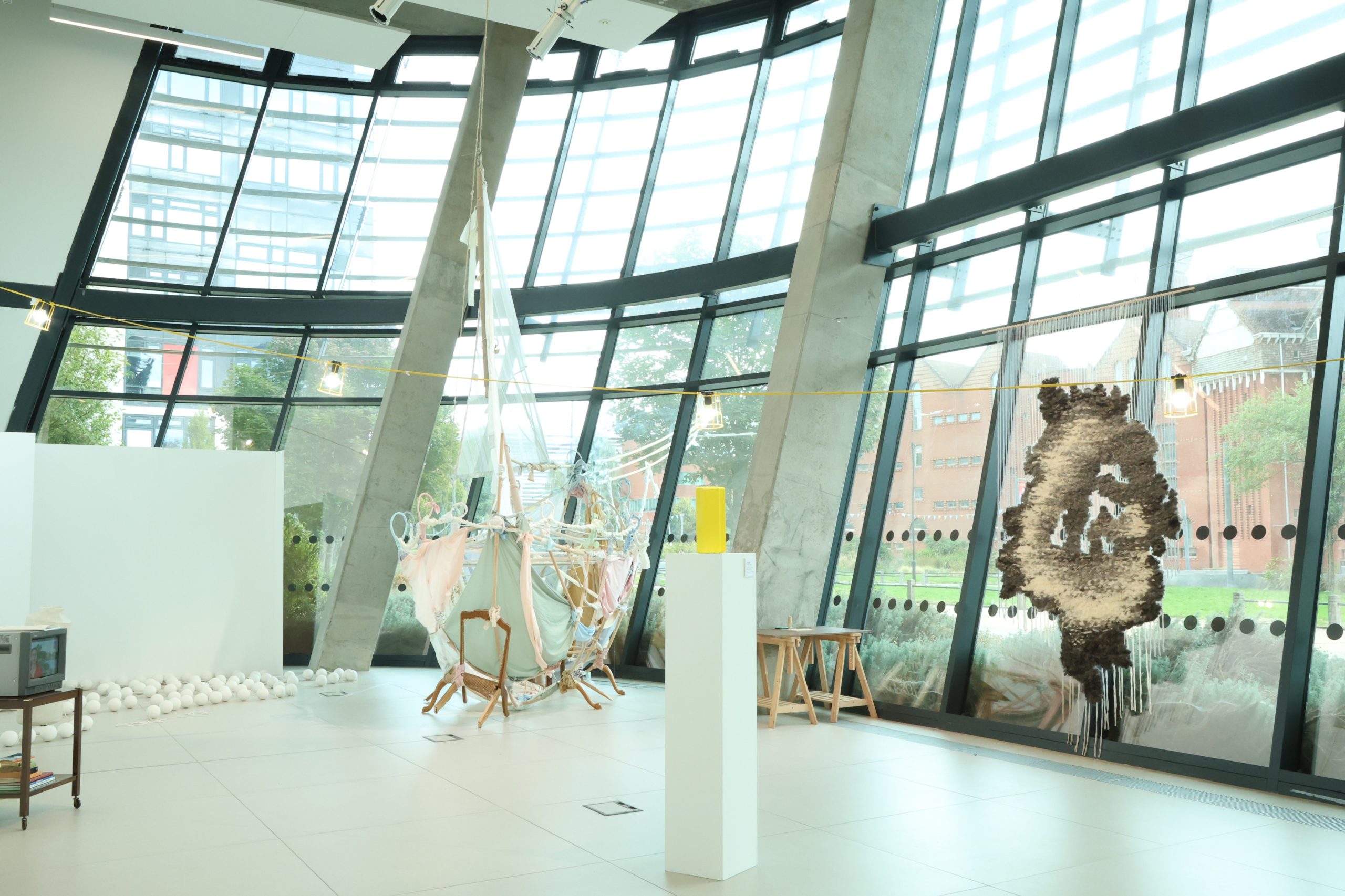
Upon entering the Leicester Gallery, I’m met with a swathe of joyous yellow. The usual entranceway floor has been enveloped with lemon-yellow lino: I have unknowingly stepped right onto the work of Stephanie Ball. ‘Study in Yellow’ (2026) is a caress of colour that draws my eye as it meanders through the gallery, up into the large windows which frame the exhibition space and down again to form an almost complete loop of the gallery. The question of functionality lingers: festoon lighting, sand bags, tape and ladders have seemingly abandoned their 9-to-5s to occupy the space not as objects or things but as something beyond this. A borrowed painting, a ceramic and a pile of books also join in the sequence of celebratory yellow, adding to the thread. Ball’s work holds the space precariously, propping, balancing and wedging itself, creating the feeling that anything could give way or spill out at any moment.
This precarity extends to the work of Naomi Hewson, whose interest in transience informs her use and re-use of found objects. Fabric and wood have been painstakingly entangled to craft a boat, entitled ‘Chin Up, Chest Out, Onwards’ (2026). Its mast and sails hang from the ceiling while the ship’s bow extends out through the glass windows of the gallery. The positioning of Hewson’s boat feels reminiscent of the boat-like hanging sculptures of South Korean artist Lee Bul, and certainly the image of a boat is not uncommon in art history, from John Constable to L.S. Lowry, from Yayoi Kusama to Yoko Ono. And yet, Hewson’s boat harbours a tactility and ambiguity more akin to the work of the American fibre artist Judith Scott. There is immense majesty in the form, and as suggested by the title, a sense of hope as the vessel is breaking out and embarking on something new. And yet, after closer inspection, this triumphant form seems fatigued by its own weight, drooping at the edges. Perhaps Hewson’s ship has already sailed, and is now moored after a long journey; its ghostly translucent fabrics, frantic knotting and splintering wood suggest that something at least has come to an end. The gathering of materials began at the artist’s home; Hewson deconstructed her own dining room chairs as she could no longer keep them due to, quite aptly, moving to live on a boat.
You must get close to Hewson’s sculpture to appreciate the bobbles of fabric, the smell of old detergent, of someone’s shampoo on their pillow case and the ironed lines of a muchloved tablecloth. The materials have met an endpoint of their usefulness as functional objects, but this end is also a liberation. The materials can now speak, telling stories of lives lived elsewhere. The artist has captured the comfort and safety of domestic materials while also transforming the objects she uses, giving them a new lease of life. There is a sense of catharsis. Light shines through the pale pinks, blues and creams, highlighting torn edges and unexpected gaps. For me there is always something special about viewing a site-specific work like this, knowing that it cannot exist again in the same configuration. The knots will be undone, the wood repositioned and yet the material will always remember, the fabric will hold the creases and folds. Hewson’s work is anchored in a devotion to the materials used.
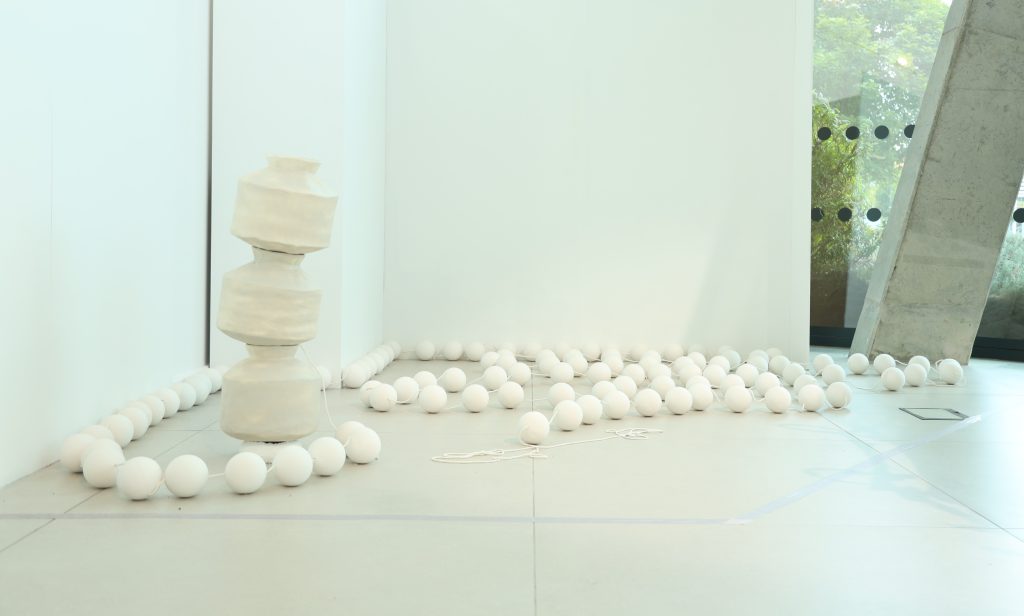
The space is full of vessels: Stephanie Ball’s balloons, Layla Pilcher’s shopping trolley, Sam Greenlees’ boxes. The question of what it means to have a vessel, and carry it forward resonates in Neeta Naker’s sculptural installation. Naker’s practice centres on tending to stories that might otherwise be lost, transforming them into something enduring and tactile. Speaking from a place of loss and grief, ‘The Sacred Thread of Generation’ (2026) incorporates three white vessels sitting on an indhoni (a circular cushion used to distribute weight when carrying heavy vessels on the head), from which 108 enlarged ceramic prayer beads spill out onto the floor; a stoic monument in memory of the artist’s mother. Unlike actual indhoni and prayer beads, these replicas have been drained of colour. The light taupe and raw clay is pared back, there is no pretense or embellishment needed. The artist has said that she is speaking of her mother’s early physical labour (such as collecting water) to her later devotional practice. The labour of motherhood and of sustaining a family is felt heavily as the work is weighed down onto the gallery floor, grounded to the earth. Naker’s mother’s prayer beads become symbolic of a lineage, the string becoming a timeline of generations. The brittle nature of the slip casts speak to the fragility of the family network and of life itself. And yet, in spite of this fragility, ceramic as a material can be preserved for centuries, enduring into the future.
This perseverance associated with womanhood and motherhood is also felt in the practice of Pilcher. Her three sculptural works, ‘Bubble Bubble Pop’, ‘Get Your Tits Out’ and ‘What’s for Dinner?’ (all 2026) sit together just around the corner from the other artists, intimately in a room of one’s own which is ironically right at the base of a stairwell, at the centre of various exits, store cupboards, and public toilets. An unmade bed, a park bench, a bin and an aforementioned shopping trolley are all lined up as a disembodied montage of a mother’s daily routine. A hidden speaker projects a baby’s cries and suckles out into the space. In this collection of objects I feel a mother’s presence, her neverending and cyclical labour. The immense tenderness of the sleepless bed might feel in stark contrast to the black security spikes that the artist has applied to the child’s seat of the trolley, and yet motherhood inhabits these extremes so fully. The work speaks of endurance, strength and resilience.
Addressing a different kind of labour, Samira Boumecid’s wall hanging references traditional craft techniques and agricultural graft. A tapestry, incredibly tender in its sensitive use of texture, colour and form, takes local wool from an endangered species of sheep, preserving the raw fleece exactly as it was shorn from the animal’s body. This wool is not re-worked, not transformed through labour nor entered into commerce, but is instead held up and respected in its raw state as a testament to the animal from which it came. These ecological underpinnings are rooted in Boumecid’s dual Algerian and English heritage, and she takes deep inspiration from her ancestors’ appreciation of nature and the land that sustains life.
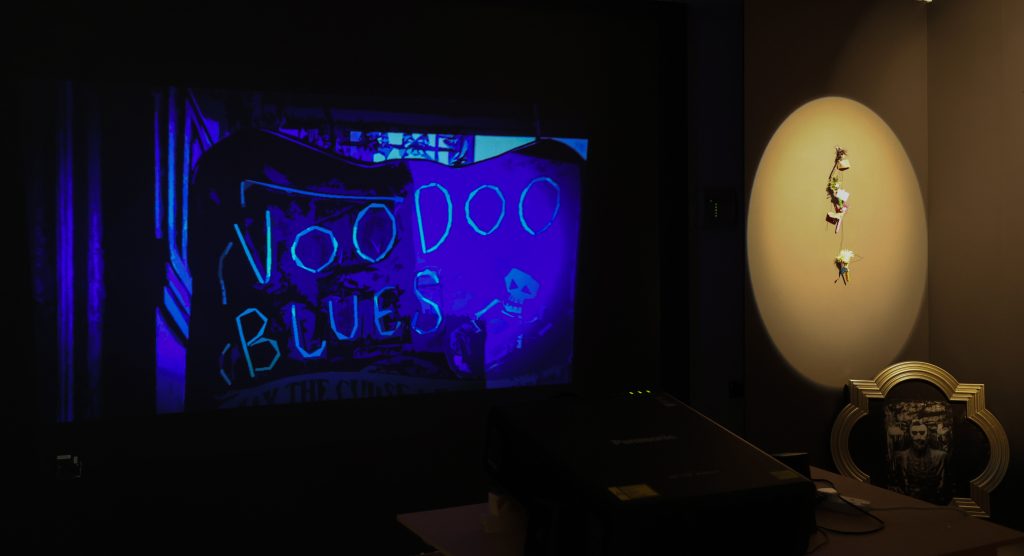
The importance of land is also seen in the work of Samantha Doyle and Sarah Liquorish, who both vividly explore site-specific storytelling to excavate histories and moments. Each artist invites you in, but in very different ways. Liquorish’s work ‘Spirits of Crescent City (2026) physically draws you to a darkened room filled with voodoo dolls, vampiristic symbolism and vivid distorted projections of her travels through New Orleans, Louisiana. Doyle’s use of cleverly warped large-scale photographic prints ‘Landscape. Altered.’’ (2026) position you as a figure within various sublime landscapes. Both artists question how a particular place can unexpectedly evoke emotion, which also extends to Amelia Ryska’s participatory practice. Through examining mundane spaces and everyday moments, Ryska hopes to find instances of wonder. Her work is positioned as six egalitarian work/play stations around the space. Each station provides a workbench, a lino cut, paper and ink. Visitors are encouraged to become active participants, as Ryska invites us to use each station to ‘make a sandwich’, layering imagery of bread, tomatoes and cheese. The final station asks the participant to display the sandwich inside a fridge, so that it may be viewed as part of the exhibition. The importance of participation and play here is central, and I embrace the joy of being invited to be a co-producer in a collective work.
Rather than bringing the viewer in as directly as Doyle or Liquorish, Emma Truter strictly positions the audience as a spectator. At first I’m struck by an unsettling sense of voyeurism: the artist has photographed loved ones through their windows. During my visit Truter admitted that the images are staged, and that she found the process of taking them deeply uncomfortable, a fact which makes the work all the more interesting. The artist urges us to question what is real and what is fabricated. Her multifaceted display of pink-framed photographs are hung up politely next to a large gray-scale image of a door into a hotel lobby. To the right of these, a gold-framed portrait of Donna Grey aka ‘The Pink Lady’ sits above a Sony Trinitron CRT monitor on a dark wooden side table, accompanied by a booklet outlining the supposed archives of this fictional character created by Truter. Truter plays the role of a fake news reporter on the vintage TV, nonchalantly recounting the life and death of The Pink Lady while news of bombings pop up at the bottom of the screen. The satirical news reporting is a direct questioning of authority and power. A stack of books sit beneath the TV, at the top of the pile is Marcus Aurelius’ Meditations. We must assume it is intentional for the viewer to question how the Stoic notions of rationality and self-awareness relate to the satire we are presented with. Is the artist giving us the tools to question disillusionment, encouraging deeper perception?
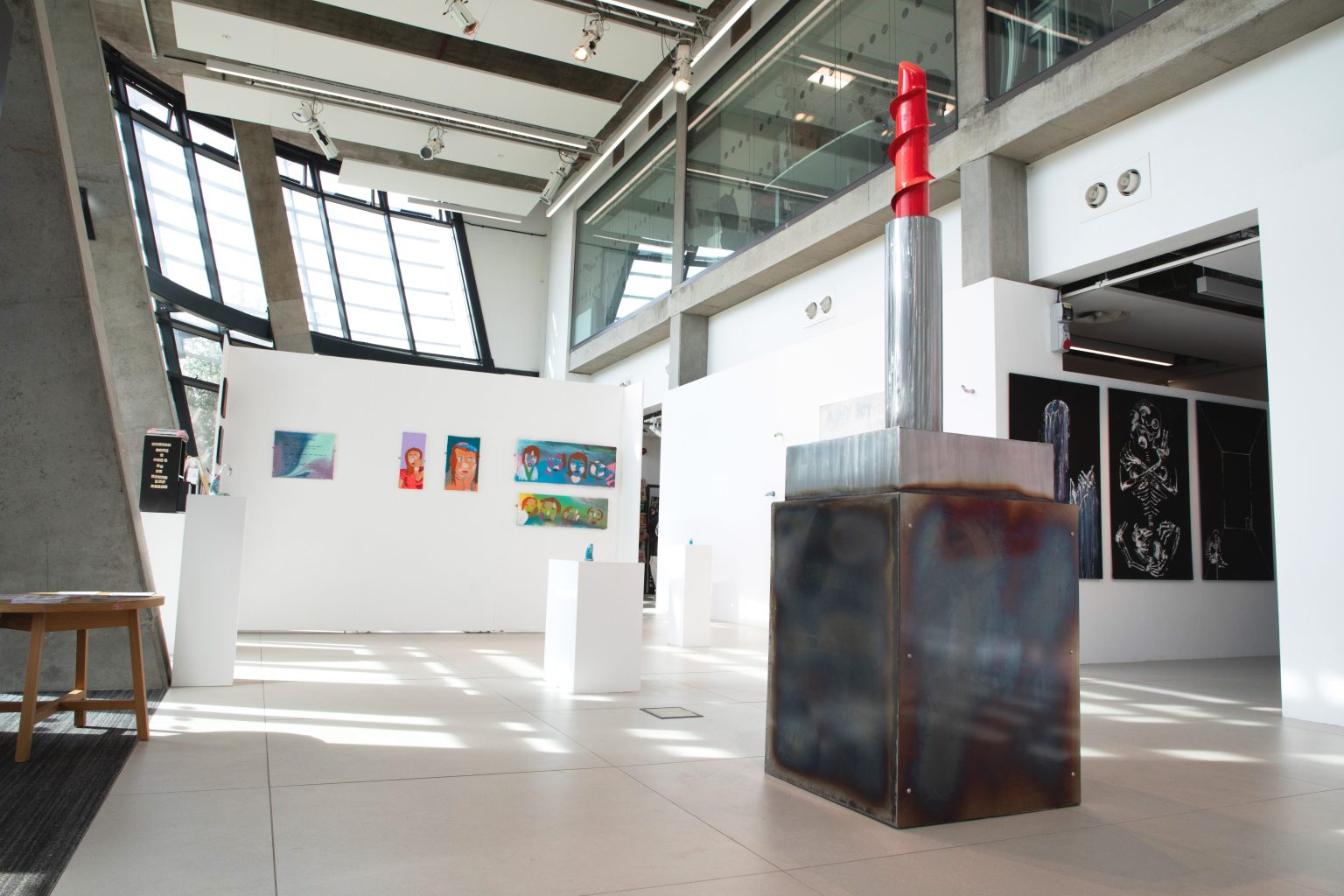
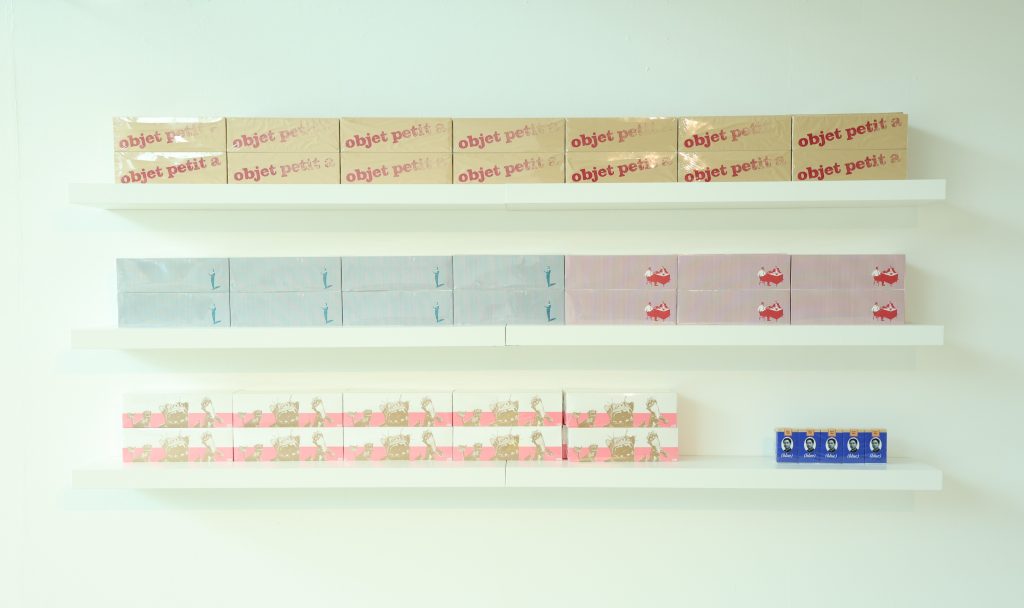
Sam Greenlees’ ‘Duty free booze and fags make me feel ill’ (2026) is an impressive display of faux cigarette packets which is similarly brimming with satire. Three rows of shelving showcase several distinctive screenprinted designs conceived by Greenlees, and wrapped in cellophane. The display perfectly mimics those sterile arrangements found in airport departure-lounges, so much so that I almost feel the urge to reach out and take a box. Greenlees exposes this deeply embedded consumer desire and prompts the viewer to rethink how that desire operates. The screenprinted images of Clint Eastwood, male office workers, Mao Zedong and his paper tiger present this desire as uniquely masculine. Greenlees’ practice questions whether male desire is destined to instigate outward violence or self-destruction. The artist does not scorn Eastwood-esque portrayals of masculinity—rather he finds that there is still enjoyment to be found in them—but this is accompanied by a healthy dose of self-awareness and critique. The inclusion of the paper tiger, as popularised by Zedong in the 1940s to describe American imperialism, implies something which appears powerful but is, in reality, weak and useless. Positioning the term ‘objet petit a’ across the boxes on the top shelf is particularly apt, as French Psychoanalyst Jacques Lacan’s ‘object of desire’ is certainly out of reach here in more ways than one. Just like these sublime objects that are essentially ungraspable or always at the periphery, Greenlees’s work successfully leaves you wanting more.
Nearby, Paul Mazzitelli’s impressive monolith stands at the intersection of art and engineering. The physicality of his sculpture takes inspiration from Spomeniks, the World War Two monuments of former Yugoslavia, many of which have now crumbled. When first encountering Mazzitelli’s work, I was met with a solid block of grey; a faux-concrete obelisk, referencing a futuristic Modernist past. It would be easy to think that the piece is part of the building’s architecture. It is only when I circle the towering work that I encounter a computer screen, glass bricks and lights inset into the faux-concrete. The screen and lights are synced together in constant motion, with unknown data refreshing routinely in front of me. Mazzitelli questions how we can ‘amplify ourselves through technology’. Given the current explosion of AI, the notion of Cybernetics feels suitably vintage. But it acts as a reminder of the feedback loop we find ourselves in, as referenced through Roy Ascott’s Cybernetic art. The question of how artists can embrace a dialogue with technology has never felt more pertinent.
University ‘Degree Shows’ are sometimes uncomfortable exhibitions, presenting as a hodgepodge of little solo shows or as a battle of egos between disparate styles and ideas; corridors still echoing with the squabbles for prime floor or wall space. It is rare for a Degree Show to feel quite as coherent as Tend/ does, both conceptually and curatorially. I sense a genuine respect between the artists, for each other, and each other’s work. To be tender and to offer up tenderness can be a vulnerable act. Such sensitivity is not always met kindly in the artworld, nor is it appreciated. A small section of the exhibition acknowledges the lineage of arts education on the site, beginning with the Leicester School of Art, founded in 1870. The artists express solidarity with their peers gone by, and the unfortunate state that creative education is heading in, which is particularly poignant as it was announced at the opening that this cohort would in fact be the last on the MA Contemporary Art Practice. The course is now suspended, a pattern that is repeating itself at Universities and Art Schools across the country. This show acts as a reminder that even when faced with closures and indifference, we must keep tending to each other and our art.
TEND/, Leicester Gallery, De Montfort University, The Gateway, Leicester, 5th – 11th September 2026.
Poppy Jones-Little is a writer based in the East-Midlands.
This review was supported by the artists.
Published 10.10.2026 by Rachel Graves in Reviews
2,335 words