It is fitting that the first exhibition in BACKLIT’s new ground-floor gallery presents the imagined landscapes of Xin Chen and T’kya Xavier, early career artists working across ceramics, painting, textiles, collage, film and performance. Curated by Jazz Singh Swali, Lands of Uncertain Shape comprises ten artworks, four by Chen and five by Xavier, and culminates in a collaborative artwork.
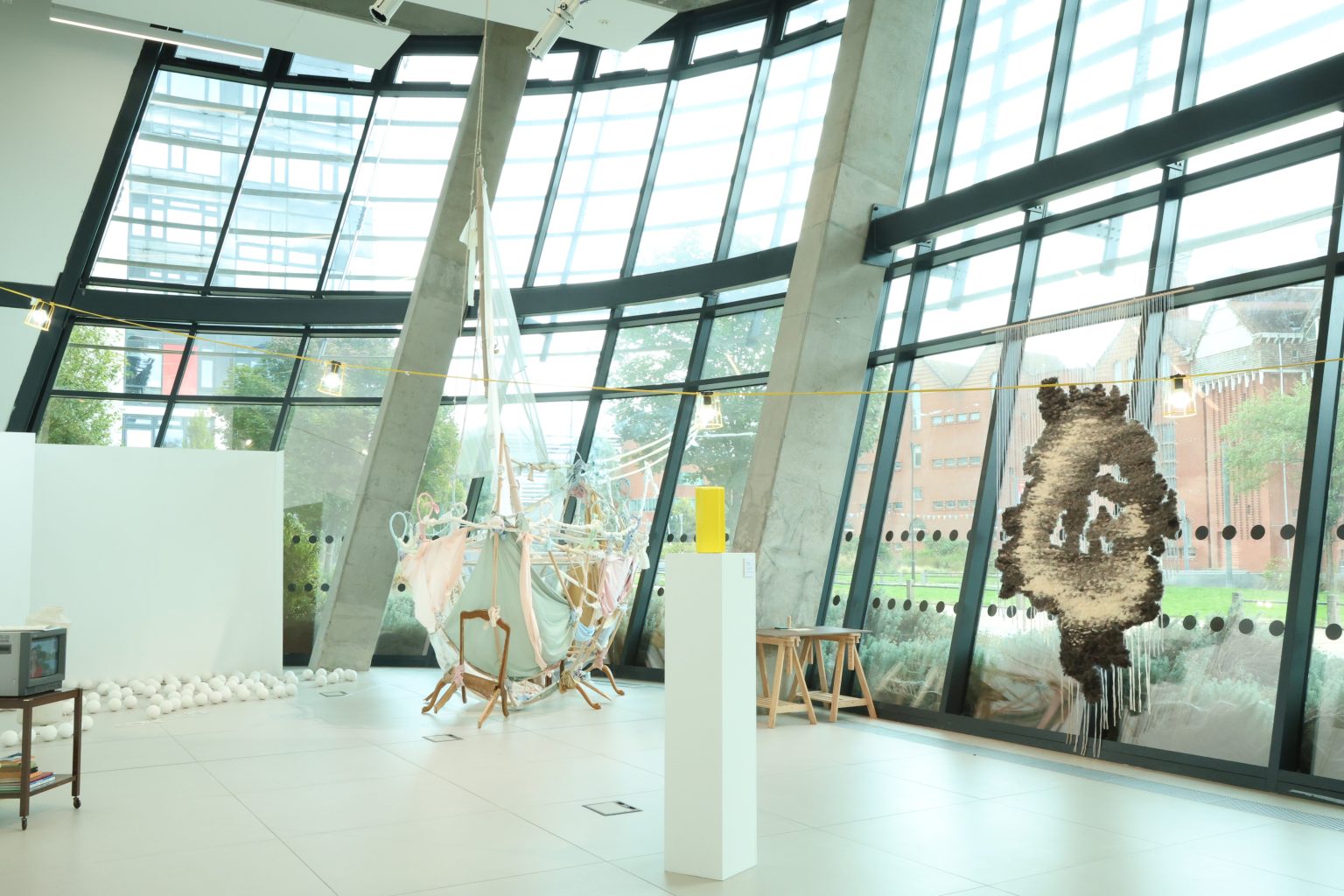
Large arched windows flank the outer walls of this former Victorian factory in Nottingham, letting in crisp sunshine. Cushioned by the hum of café clientele, I’m immediately struck by the gallery’s bright airy atmosphere. Natural light illuminates BACKLIT’s recently painted inner white walls, creating a neutral backdrop to the expansive artworks displayed throughout this redeveloped open-plan area, which now includes an archive and workshop space. Traversing the gallery space, there is a feeling of slipping in and out of Chen’s small, surreal architectural sculptures and meditative landscapes on canvas that unfold alongside Xavier’s playful, gritty, more grounded assemblages.
When I arrive at BACKLIT I am greeted by the exhibition’s curator, Jazz Singh Swali, who tells me his aim in programming Chen and Xavier was not to “force a pretend theme” between their art, but to take the audience and the ways in which we experience galleries “back to basics [focusing on] shape, colour, play, and materiality.” The goal, refreshingly, is for visitors to enjoy themselves. As such, the resulting exhibition feels like a wandering through two simultaneous timelines, which, assisted by the fluid layout, proves to be a fun experiment.
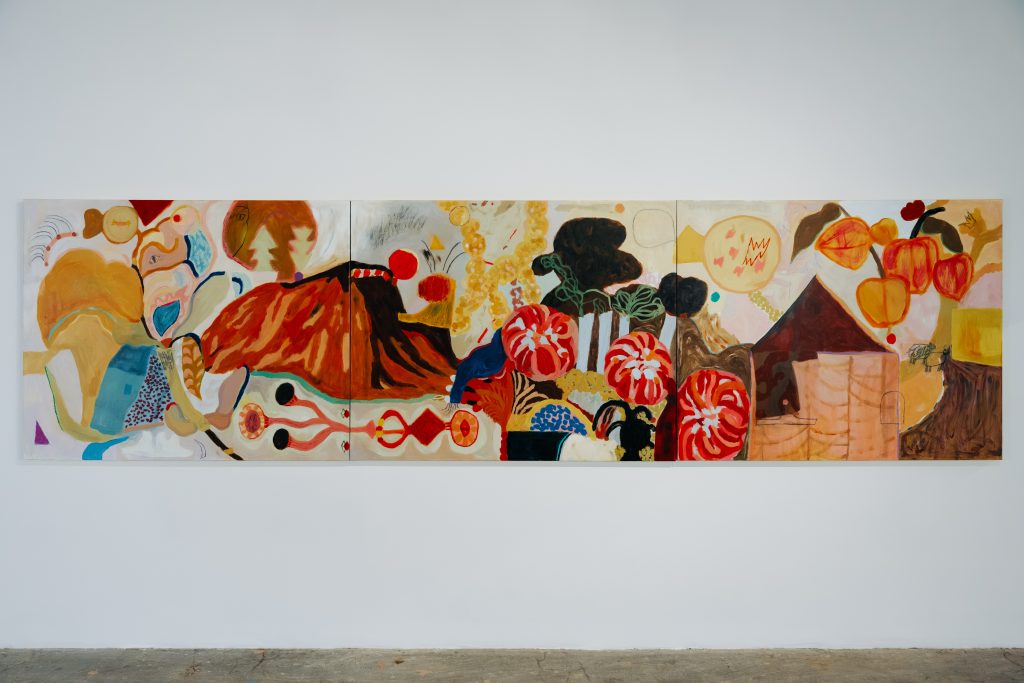
‘When You Are Quiet’ (2026), the first work I encounter by Chen, is also their largest. An abstract, mountainous landscape held by three wide canvases sits in the wall’s centre, its mid-line about eye level. Night and day appear to unfold at once as an alien-like body lies at the bottom of the left and central panes, watching their pulsating surroundings with a petalled, unflinching red eye. There is a lot to take in, with plenty of delicious details to puzzle over. An owl peers out from a golden moon; the cross-section of a house reveals dragon fruit-like seeds; rogue body parts float in space as a mountain slopes towards a dark climax. The sunnier, busier right-hand panel eschews scale as branches heavy with fruit eclipse the animals at its trunk, unearthly flowers dominating the space.
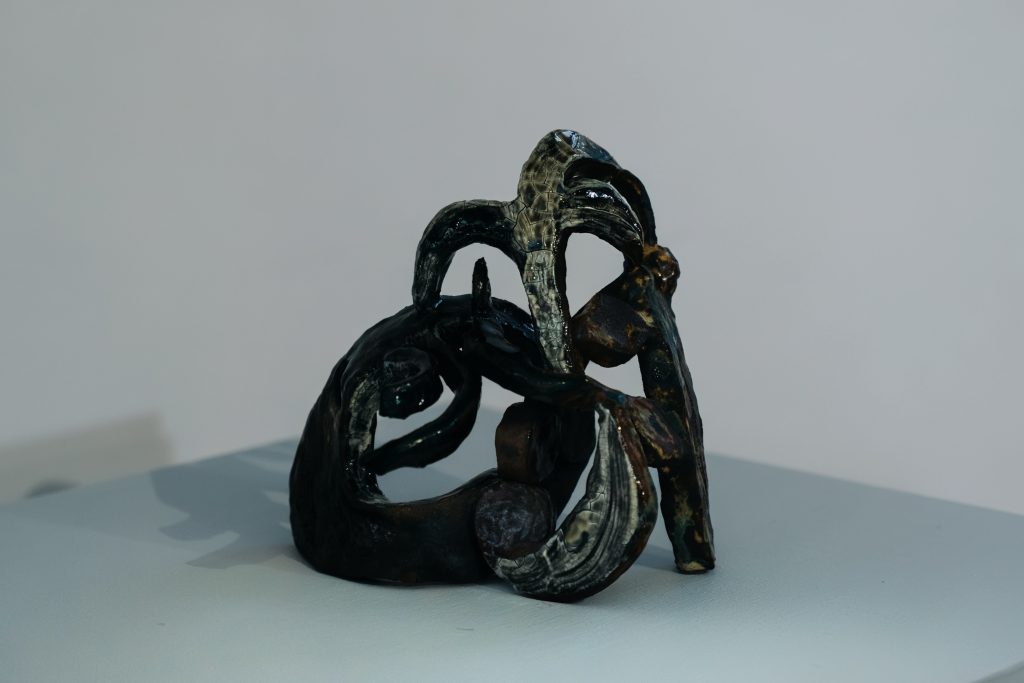
Moving on from this expansive trio of canvases I encounter a quieter ceramic sculpture, roughly 30x30cm. ‘The Rooftop’ (2024), also by Chen, incorporates familiar fluid shapes that here are condensed and rendered in a much more muted palette. A central palm tree’s fronds wrap into other curves, its varnish crackling and contrasting against other muddier contours whose surfaces appear almost bruised. The next work, ‘To the Last Concert’ (2025), has a similar structure to Chen’s ‘Rooftop’ but this time unfurled and outward facing, sculpted in unglazed earthenware. Here, the palm harmoniously crowns the sculpture’s looping arms, which let in more light to contrast against the surfaces occupied with pastel patterns. I take pleasure in circling it slowly, following the illogical contours in search of its hidden written messages alongside painted animal forms and houses.
Chen’s newest work, ‘Jealous’ (2026) sits on the opposite wall. Another exploration in mixed media that, again, feels like it’s turning inward. While the palette of Chen’s larger paintings is present here too, the darker tones and clashing patterns dominate this smaller canvas. An outline of a strange 3D house draws my eye, as I can see the porch, back wall and side at once. There are no figures in this piece; perhaps the titular mood has cast the house enviously adrift. Informed by “Taoist ideas of spontaneous action”, Chen’s works are meditative snapshots into a cohesive and fully developed imaginary world. Balancing the interiority of ‘Rooftop’ with the exhale of ‘To the Last Concert’ shows how moods shift and change, written on their architecture. The rich, repeated symbolism creates a codex of personal mythology that invites me to spend time musing upon multiple possible meanings that remain just out of reach.
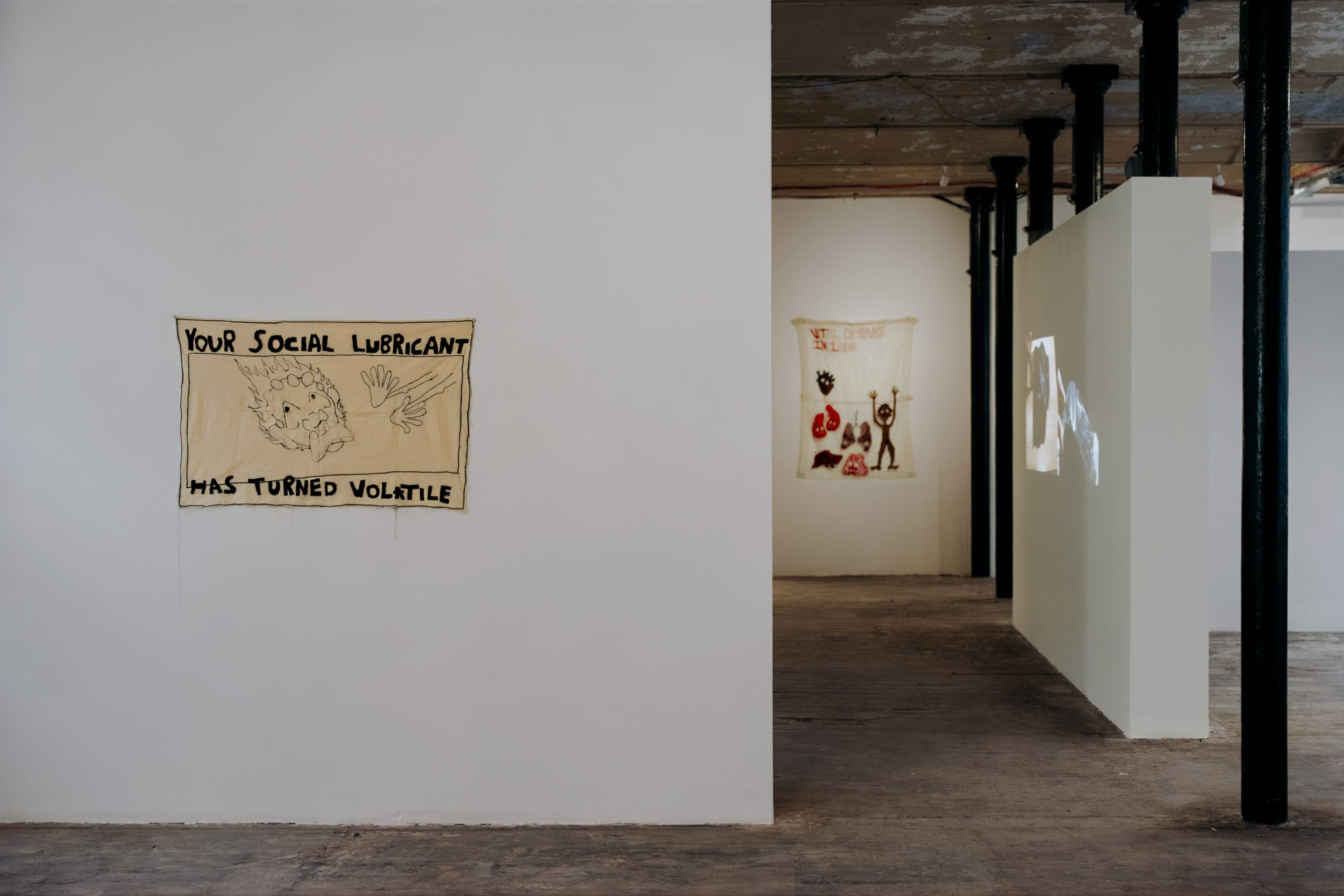
Similarly colourful but more direct in their exploration of queerness and mental health, the revelrous, reflective journey across Xavier’s work begins with ‘Ode to 400 Rabbits’ (2026). Created, like all of their works, using found and recycled fabrics, a deep blue banner with black and white batik lettering reads, “I GET SO GAY OFF THAT TEQUILA.” My laugh echoes around the gallery. Fringed with white tassels, the shape reminds me almost of half a jacket; the other half presumably left at the Nottingham tequila bar the piece is named after. Across the room, the jubilance of a night out tips into uncertainty with ‘Social lube’ (2026). Xavier’s rectangular canvas is like an uneven cartoon panel, absent of colour, with a central figure’s head stitched with flames and bordered by uneven block letters: “your social lubricant has turned volatile”. A disembodied pair of arms pushes the head away as the discordance of a soured social mood is writ on the creased blank fabric. In the next space, I grin at the title of a video installation, ‘My head is great! Thanks for asking Part 2’ (2026), which sees the artist themself arranging and dismembering several heads bearing their own face, complete with various weaves. Brandishing a blue-handled pair of scissors with glee, Xavier plays to the camera, layering one of the head’s hair over their own before snipping it open to reveal stuffing and, in one case, a red worm. Xavier seems to be winking at the viewer, inviting us to laugh with them amidst the darkness in this absurd scenario. They tackle queer mental health with surreal gusto in a shrug that says to me ‘yes things are shit, but at least make it funny’.
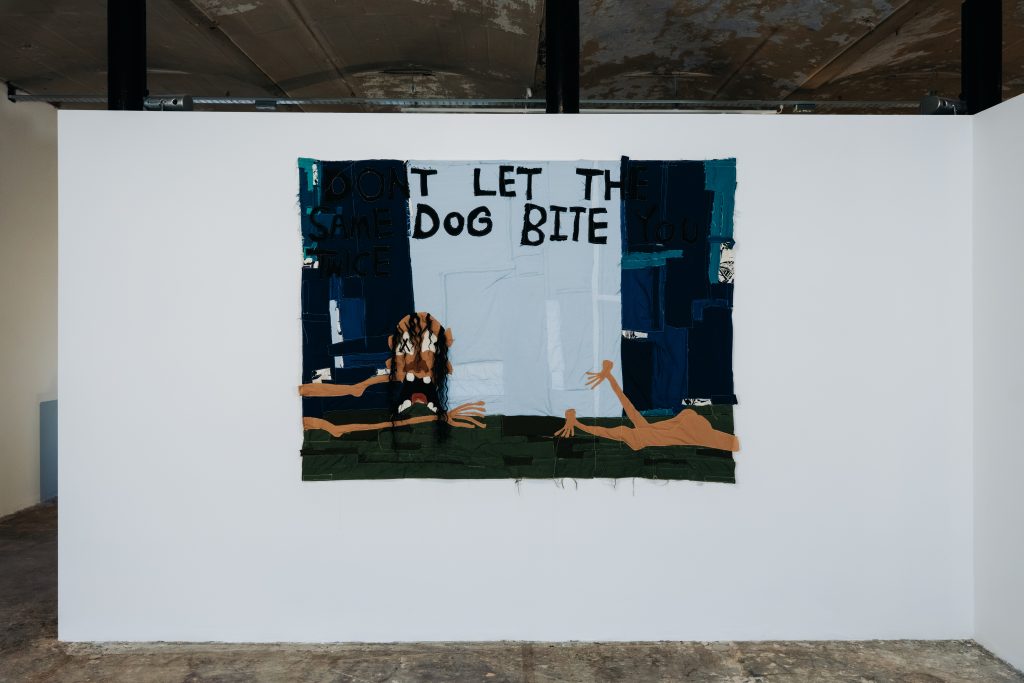
In ‘Vital organs’ (2026) the same cornrowed figure from ‘Social lube’ is once again partying, this time in full-colour nudity, with anthropomorphised innards on its outside. Despite the figure’s joyful pose, their organs upstage them: brain frowning, lungs coughing, kidneys looking down at the silky crimson liver’s caricatured death, flies buzzing. Only the heart, rendered in rough, dark fabric, looks out to the viewer with an expression fighting neutrality. The last of Xavier’s works is titled ‘The Big One’ (2026) in which a wavy haired figure is bisected, crawling across a khaki green panelled floor as the top half of their body grimaces and chases the other end. Block lettering, emblazoned across the canvas, is almost swallowed up by the darker blue walls that frame a light blue central doorway. Nestled amongst the blues are swatches of the batik fabric that appears in ‘400 Rabbits’, continuing the storyline from night out to the morning after, as the figure urges of themselves: “DONT LET THE SAME DOG BITE YOU TWICE.” The large fabric piece conjures the safe and the familiar upended by hangover anxiety. Xavier’s works are overt, yet clear, but invite closer consideration of their audience. Swali tells me that the fabric lettering of ‘400 Rabbits’ came from a shirt found at an after party, which leads me to wonder where the artist found their other materials, and whether the idea for the work came first, or was influenced by the textures and provenance of the fabric itself and the party’s atmosphere.
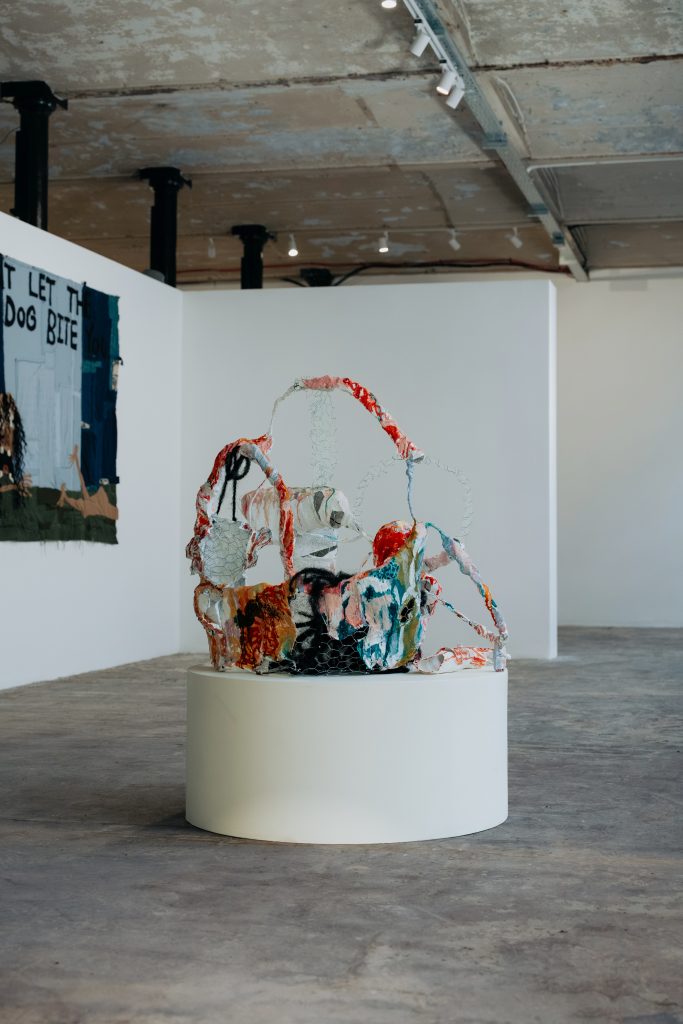
The exhibition finishes with ‘Uncertain Shape’ (2026), a new sculptural, mixed media work that the artists collaborated with each other to make. Less harmonious than their individual works, it nevertheless proves a fruitful exchange in combining their own distinct aesthetics. Chen’s smooth architecture provides the foundation but is roughened, as the wire netting that scaffolds their constructions is intentionally exposed. Xavier’s central figure takes melds into this framework, papier mache limbs splaying out from unexpected angles as an unfinished head hangs precariously from knotted, wavy hair. The ‘uncertain shape’ in question may not feel as polished as the individual works in the exhibition, but collaboration is often to play and find out through the process of making together. Moving across textiles, film, sculpture, and canvas, there is a distinct tactility uniting the practice of Chen and Xavier, lending themselves to a kind of haptic uncertainty and a feeling of malleability in the hands of the artists. While there are darker moments at play here, uncertainty is a state or mood to revel in, not despair at. By allowing their audience’s minds to wander, both practice and praxis are channelled as artist and viewer unite to wonder what these uncertain worlds could be.
Jennifer Brough is a disabled, slow writer and workshop facilitator based in Nottingham.
Xin Chen and T’kya Xavier: Lands of Uncertain Shape, BACKLIT, Nottingham, 6–28 November 2026.
This review is supported by BACKLIT.
Published 20.11.2026 by Rachel Graves
1,537 words