My first thought: razor blades. Giant sheets of metal spattered in red. Bloody fingerprints on the surface. A violent image arriving in my mind, in a show that is otherwise subtle. My initial feeling isn’t fear exactly, but a flicker of unease — a reminder of the physical risk that sits quietly beneath industrial labour.
This is my reaction to the hanging sheet-metal works in Nicola Ellis’s solo exhibition Exercises in Knowing at HOME Manchester — the first of two new solo exhibitions presented concurrently alongside Gabriel Kidd’s I Found the Giant and He Was Dead — and it’s a reaction Ellis tells me she doesn’t resist as we chat ahead of the opening. The works are composed of scrap sheets of steel, with precise holes punched out reflecting industrial consistency. They resemble SIM-card packaging: the skeletal remains of something once purposeful.
At HOME, the exhibitions unfold sequentially. Visitors encounter Ellis’s works first before passing through into Gabriel Kidd’s environment beyond. The transition is striking: from the ordered logic of production to something softer, stranger, and already in the process of falling apart.
Ellis’s works emerge from her long-term collaboration with steel enclosure manufacturer Ritherdon & Co in Darwen, Lancashire, situating her practice inside production rather than at a distance from it. ‘There are parts of working in industry that are dangerous,’ Ellis tells me. ‘It’s gritty. It’s possible to romanticise that — and I don’t think that’s wrong — but there are risks involved.’ Her work is attentive to what industry carries with it: not just materials, but histories, habits, risks, and bodies.
Ellis’s practice resists the heroic sculptor narrative – the solitary figure imposing vision onto material. Instead, she positions herself as a facilitator, setting conditions that allow outcomes to emerge.
She speaks about working in terms of parameters rather than design. Even a small shift — like moving a factory waste product from one part of the system to another — can produce disproportionately large effects. ‘It’s like throwing a tiny stone into a big pond,’ she says. ‘You just make a small change, and the outcome is drastically different.’
Elsewhere in the gallery, plaster creatures appear half-finished: swamp monsters, disembodied arms, truncated bodies. The reference to Michelangelo’s non-finito sculptures feels apt – figures that appear to struggle free from their material. Ellis’s works similarly feel less like resolved statements and more like moments extracted from an ongoing process.
Ellis occupies an in-between position. ‘In the art world I’m seen as the industry person,’ she tells me, ‘but in industry I’m the art person. You’re always wearing a different hat.’ Rather than resolving that tension, she leans into it. ‘I actively seek out situations where I’m not an expert. The non-expert perspective has value.’
If Ellis’s exhibition feels like encountering the remnants of a system — fragments held in place long enough for us to look — then Gabriel Kidd’s I Found the Giant and He Was Dead next door feels like stepping into the aftermath of something that has already collapsed.
Plastic sheeting hangs at the threshold. I glance at it and wonder if I’ve arrived too early – if the exhibition install is still underway.
That moment of uncertainty feels like an instruction. Inside, the space reads like a Grimm’s fairy tale: not in neat narrative or reference, but atmosphere. A place where bodies are vulnerable, materials are unstable, and time doesn’t progress politely.
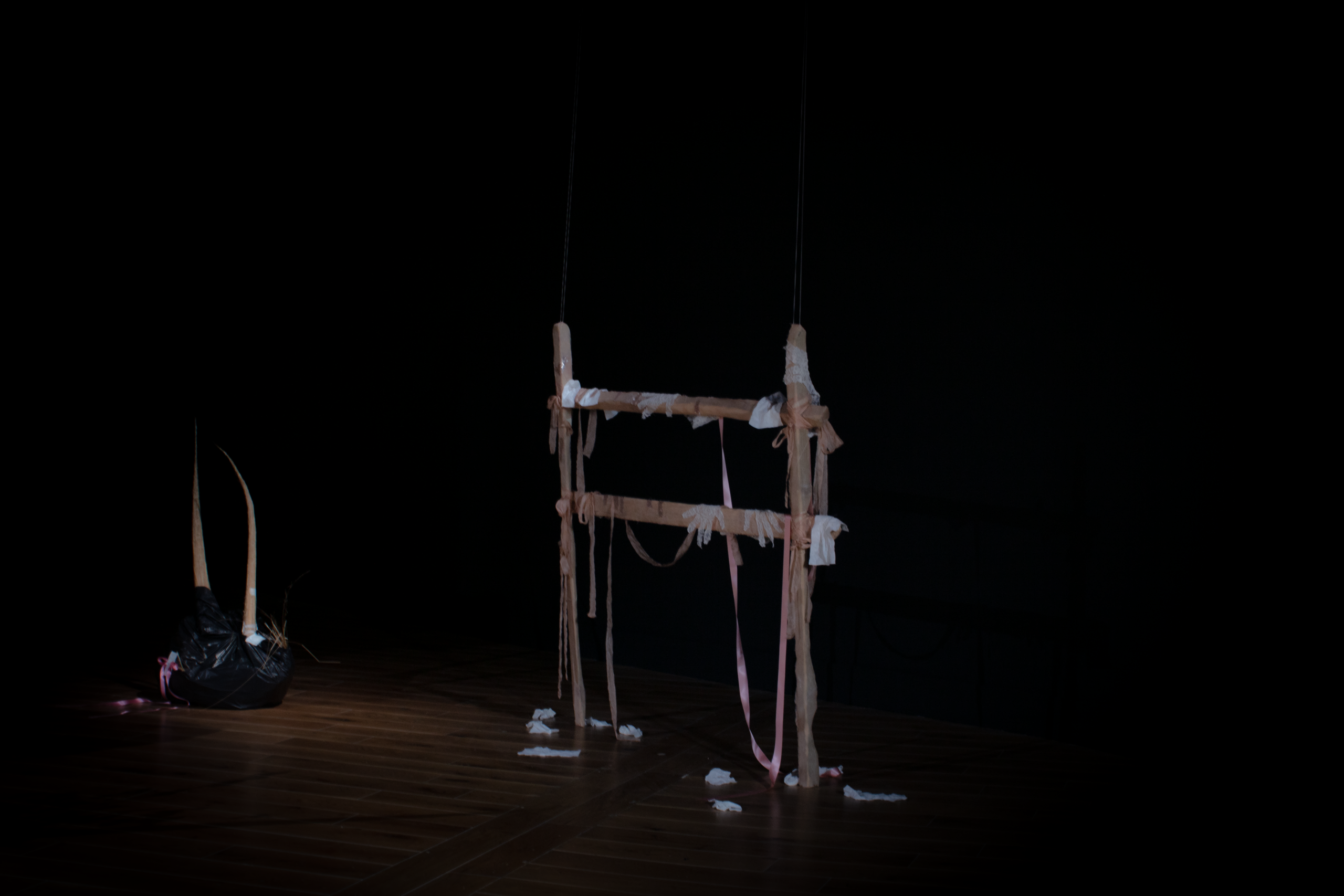
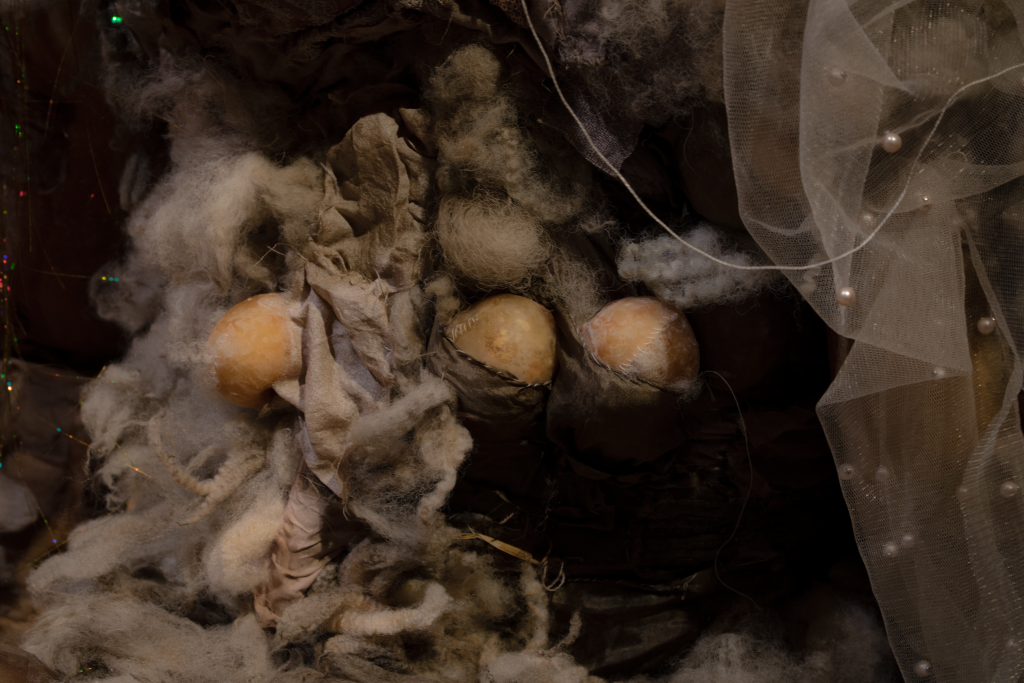
It is dark, and a pair of silky pink kitten heels catch my eye. The body they adorn is slumped, ruffled and mysterious under the spotlight. Posed like a fallen showgirl after the curtain has come down, the figure is made of latex skin, stained silk, padding, nails and synthetic ornament – a body assembled rather than born, already mid-collapse.
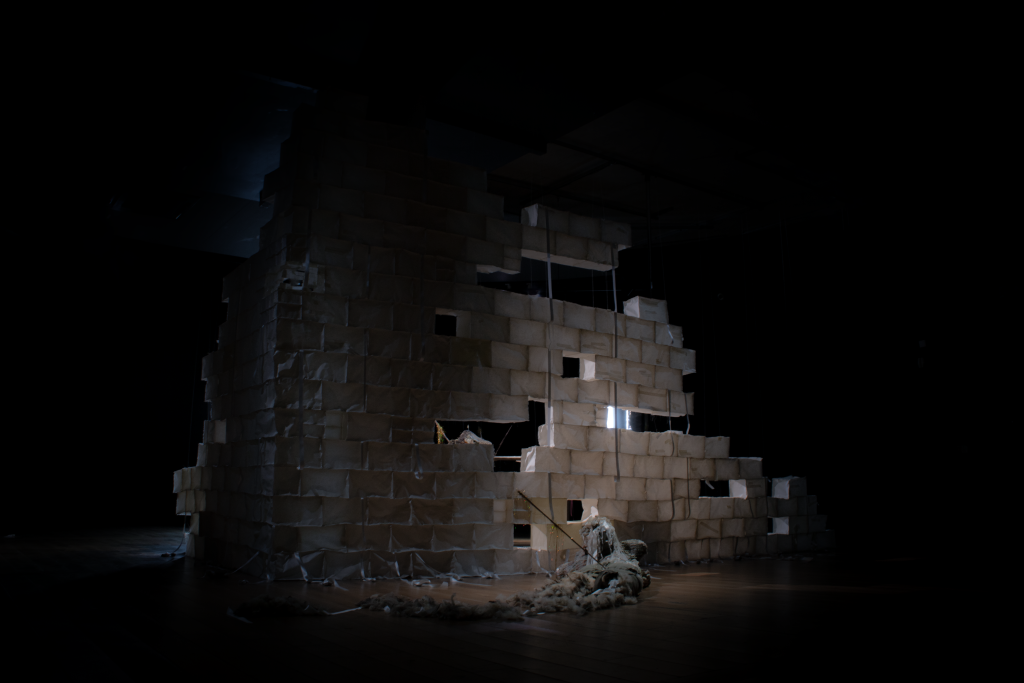
Beyond the entrance is a large structure of boxes emulating a crumbling castle, speaking to ideas of deconstruction and impermanence, of architecture held together only temporarily by belief. Slouching in front of the structure, another heeled figure appears – this time impaled by a single glittering arrow, caught somewhere between melodrama and entropy, as if even the act of wounding has been slowed and aestheticised.
Private moments between the figurative sculptures are framed through a reimagined folktale of two giants, Alderman and Alphin from the valley of Greenfield in Saddleworth, introduced through the exhibition’s accompanying text. Their story — one of friendship, love, jealousy, revenge and loss — quietly threads through the installation.
Yet the narrative never fully settles into clarity. The figures seem caught between characters and materials, between theatre and ruin. They feel less like actors performing a story than objects that have stumbled into one.
Kidd is wary of folklore being read too literally. ‘I resist the idea that the work is about witchcraft or fairy tales in a direct way,’ they tell me. ‘I’m interested in real natural processes – and the magic that already exists within them. The way mould grows, the way a body decomposes, is magic. It doesn’t need another layer of magic on top.’
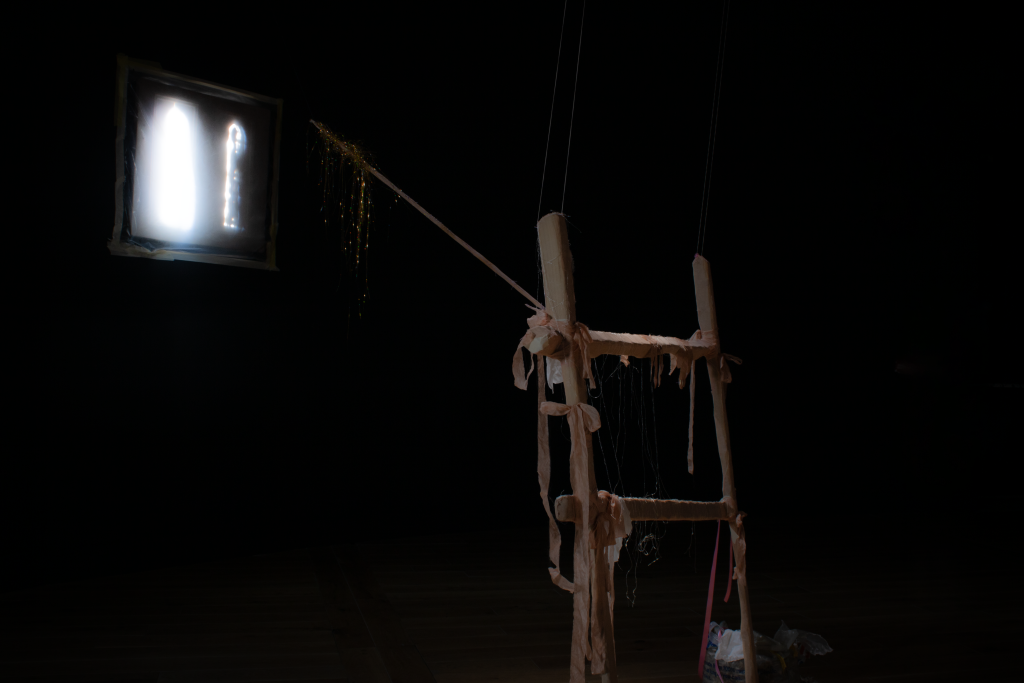
Myth here operates less as subject matter and more as aesthetic shorthand – a way of holding complexity. Kidd describes themself as ‘a science nerd at the core,’ drawn to ecology, decomposition and entropy. Witches, giants, and fairy-tale forms function as surface languages rather than explanations.
Distance has played a crucial role in these aesthetic choices. Kidd has spent time away from the North and the landscapes that originally anchored their practice whilst undertaking a Masters at Slade School of Fine Art, and they describe the move with ambivalence.
‘At first I felt like a complete traitor,’ they admit. But separation transformed their relationship to place. ‘Being far away made the landscape distant – so it could be more flexible, less directly referential. It could exist in memory.’
What emerges is not a documentary landscape, but a reconstructed one. ‘This could be on the moors,’ they say, ‘but not really the moors anyone knows – a fantasised version.’ The exhibition becomes a site of remembering rather than recording.
Kidd’s process mirrors this looseness. Their work is driven by intuition, but not in a casual sense. ‘Everything in the show has made itself,’ they say. One object leads to another; failure becomes productive. ‘I failed to get the image in my head into reality – but that failure makes the new thing.’
For this, their first major institutional solo exhibition, they describe learning to relinquish control — particularly during installation. Plans dissolve in response to the space. Objects shift, are re-positioned, or allowed to sag.
‘The logic is letting it happen,’ they say.
The materials themselves reinforce this instability. Kidd tells me that the paper bricks were battered by wind and rain before arriving in the gallery. Silk stained when left near oil-rich surfaces. Latex is deliberately exposed to light so that it will discolour and degrade over time.
These are not materials chosen for durability. They are materials chosen for their capacity to change.
Kidd doesn’t protect against damage — they cultivate it. ‘I want accidents to happen,’ they tell me. ‘I’m setting up the circumstances for things to degrade, and enjoying that.’
Seen this way, authorship becomes less about controlling outcomes and more about establishing conditions. The sculptures are not static objects but temporary arrangements of materials that will continue shifting, staining, sagging and collapsing over time.
Preservation — the unspoken expectation of institutional exhibition-making — is quietly rejected here.
‘I kind of want nothing to last,’ Kidd tells me. ‘I’d rather it collapses before I die than stay around forever.’
It’s a position that unsettles conventional ideas of value, collectability and legacy. Yet it also reframes what the work is for. If the sculptures are destined to change or deteriorate, then their meaning cannot reside in permanence. It resides in encounters; in the unstable moment of meeting them.
Crucially, this stance feels particularly resonant now. In a cultural moment shaped by compression, capture and instant interpretation, Kidd’s exhibition insists on something slower and less certain.
The installation doesn’t resolve itself quickly. It sits somewhere between theatre, ruin and ecological process — familiar materials behaving in unfamiliar ways.
Rather than explaining itself, the work allows strangeness to linger. The figures feel suspended between life and collapse, narrative and aftermath. Their internal logic is intuitive rather than declarative. Meaning emerges gradually, if at all.
When I ask Kidd what they hope visitors take away, their answer is unexpectedly tender.
‘There’s beauty in collapsing,’ they say. ‘It doesn’t mean it’s fine or right — but there’s something in accepting that things fail… and there’s beauty in all of these processes. When I don’t know how to deal with certain feelings, sadness or loneliness, it helps me to remember that expression is good; it’s amazing that we get to feel that range of emotion and reveal that range of experience — we’re not just an amoeba.’
Seen together, these two solo exhibitions form a compelling dialogue; not through visual similarity, but through a shared refusal of heroic authorship. Ellis and Kidd work in radically different material registers, yet both relinquish control in favour of systems, environments and processes that exceed them.
Ellis allows the factory to speak back. Kidd allows decay to do the same. What emerges is a shared refusal of control — an authorship distributed across machines, materials, time and accident.
Nicola Ellis: Exercises in Knowing and Gabriel Kidd: I found the giant and he was dead, HOME, Manchester, 21 February – 17 May 2026.
Mollie Balshaw (they/them) is an artist and writer based in Warrington
This review is supported by HOME.
Published 18.03.2026 by Jazmine Linklater in Reviews
1,678 words


