Titling an exhibition about queer experiences of grief and loss Vitalities seems, at first, contradictory. Vitalities connotes energy and life force, which seems at odds with death. The definition given in Collins English Dictionary is ‘the power or ability to continue in existence, live, or grow’, which speaks both to people’s ability to carry on in their grief and the indelible mark those we’ve lost leave behind. At the opening preview, Peake says in her speech that Vitalities is concerned with objects, sharing a poem she hopes gives context to her work. The untitled poem describes examining someone’s belongings after they’ve passed and ends with the lines: ‘I search for the evidence of what meant meaning to you / And I file through your meanings to search for what I might have meant to you.’ The poem highlights the duality of presence and absence that grief contains – the space that is created by the loss and the belongings that are left behind.
Vitalities is part of Peake’s current project Your Meaning Not Your Materiality 2024-2027 (YMNYM),which has included interactive outdoor sculpture work in TheCOLAB Artist Garden in London and performances at Leeds Art Gallery. A London-based artist, she has been making solo and group performance works intertwined with an extensive visual arts practice since 1995. According to the artist’s website, YMNYM questions ‘what is left when a physical and material form has died, dissolved or been removed’. The backdrop to this work extends from personal grief to worldwide extremes of conflict and climate change which perpetuate relentless loss. The project explores the force of absence of death; through the creation of permanent physical forms made from plaster to represent the intangible, Peake attempts to make absence solid.
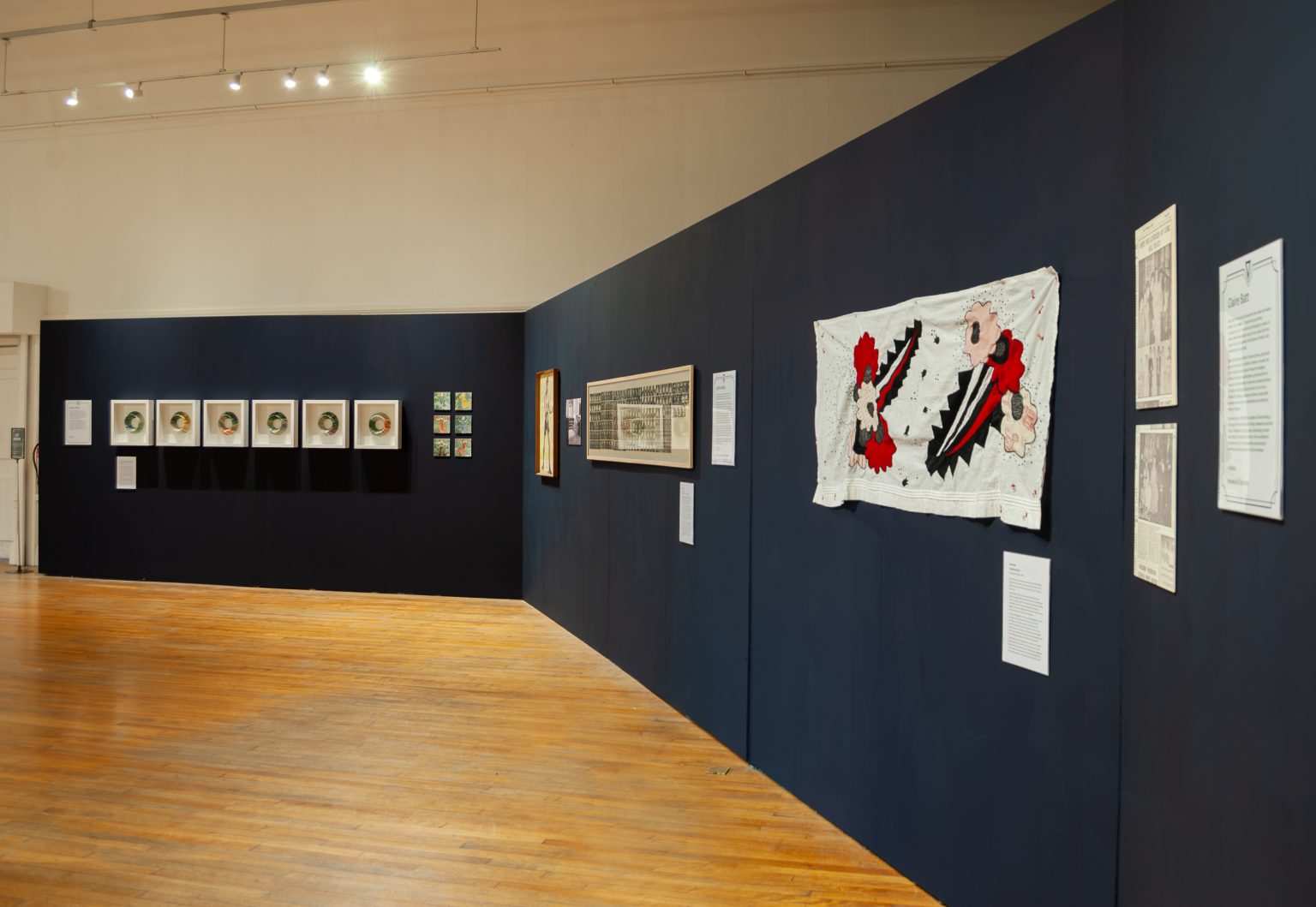
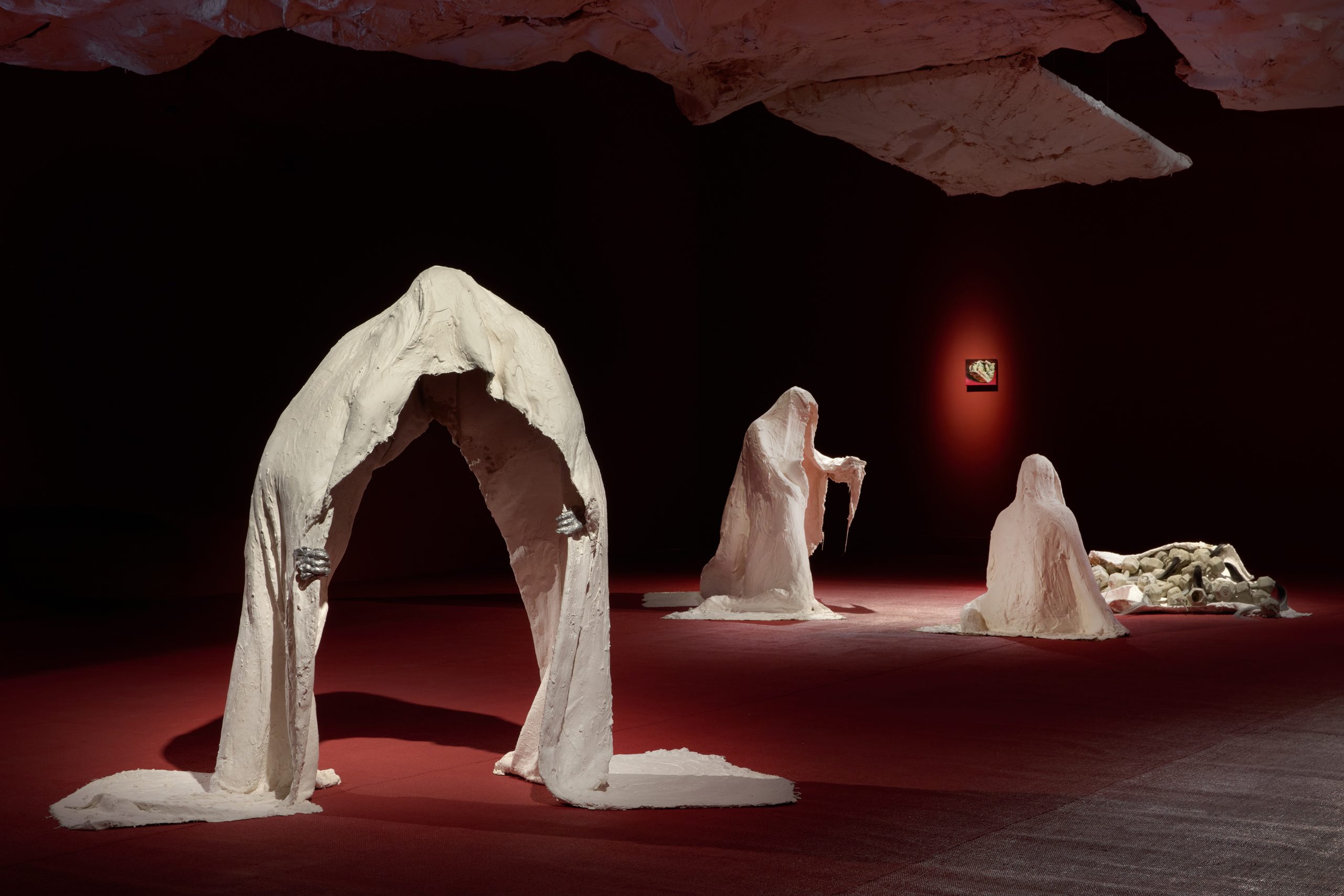
The exhibition comprises three main areas, opening with a dark walled gallery space adorned with vibrant chalk drawings. The central space of the exhibition feels quite different, beckoning visitors in with a wash of floor to ceiling red and is divided into two sections by a floating wall. In the central section, sculptures made from hessian and gypsum plaster haunt the space, many of them untitled. Most striking is a human-scale, ghost-like sculpture without a middle, that evokes simultaneously the shroud of death and the veil of the Virgin Mary. When I first saw the figure, I felt an intense sadness, as it made me think of a grieving mother, the hollowed-out space beneath, the absence of a child. When examining the structure from different angles, however, I saw an embrace between two figures, as metallic hands clasp one side of the sculpture. I enjoyed the dual interpretation of this piece, engaging with the themes of duality, of presence and absence, throughout the work. If the sculpture is an embrace, is it an embrace between the living and the dead? Or those experiencing grief?
Another stark figure lies on the floor against the wall; this sculpture is a more obvious representation of death, as it looks like bodies covered in burial shrouds. On the wall, words written in chalk run along the length of the sculpture: ‘I put one on for size / it holds the scent of your meaning / soaked through / let this disjuncture find its composure’, the words a callback to the poem Peake read. In addition to these sculptures, there is a tableau reminiscent of a nativity scene; the same ghost-like figures exist here but are even more ghoulish with jagged sleeves. Two figures form a triad, facing a mass of concrete weights filled with clumps of grey hair. Above the scene is a suspended, cracked and crumbling structure. The theme of grief felt less present to me in this scene, and I was unclear how the weights tied in. The room is broken up by a large-scale artwork on black paper, mounted on the floating wall. Here, Peake has scratched vigorously at the paper with scissors to leave marks, and chalk drawings of the recurring motif of hands appear to tear through the paper to reveal something hidden within. For me, it mirrors the feelings evoked by the first sculptural piece that I encountered, emphasising the thinness between life and death. I felt as though the works were clawing to get back to those we have lost.
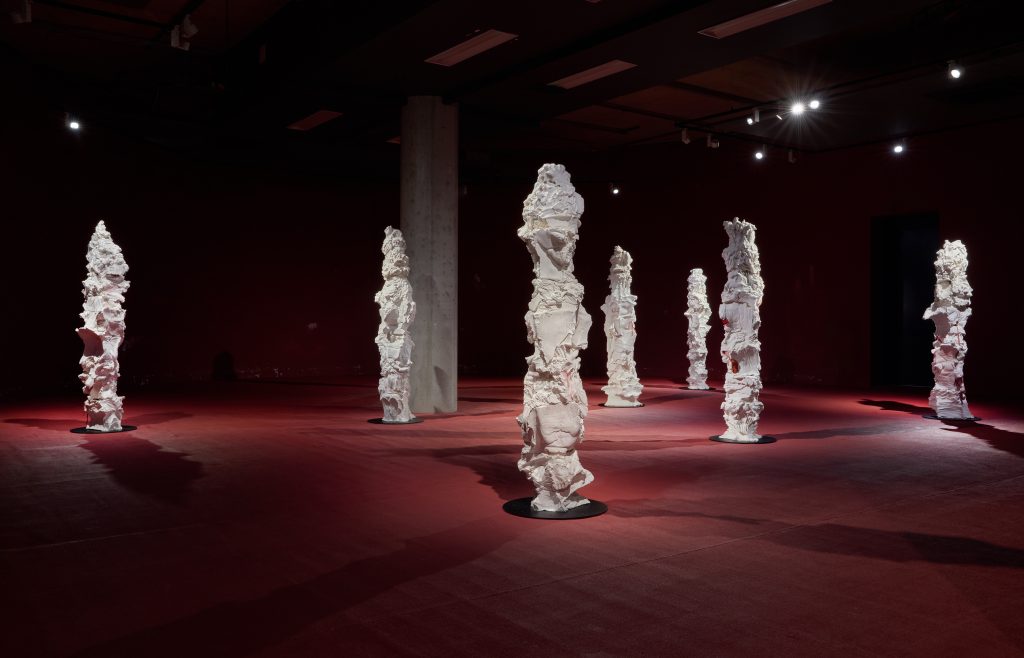
Behind the wall stand eight large structures titled as numbered ‘Totems’ (2026). The structures have been made in collaboration with LGBTQIA+ communities in and around Manchester, during workshops with participants who have experience of grief. The structures are made by pouring plaster between the participants’ bodies, making solid the space between them. As the structures stand alone, there is very little information about how they were made, and as a collaborative project, the perspective of the participants feels somewhat lacking. I would have welcomed more information about the process of making the sculptures, as without this, the structures themselves didn’t evoke the same dual themes of presence and absence as strongly as elsewhere in the exhibition.
At first glance, they are reminiscent of the used side of a nasal pore strip, containing red fabric, fibres and hair. They look like stacks of abandoned clay from a potter’s studio. The texture of the structures is somewhat unsettling, as they contain impressions of both organic and inorganic matter. Imprints of hands are visible again here, cleaving apart the material, creating the impression of being trapped. Elsewhere, someone has stuck their head into the plaster, leaving a cast of a ghostly face. The lights in this part of the exhibition are brighter too, sometimes blinding, which adds to the eerie effect. Some of the participants involved in the project attended the preview as guests, but I think personally wanted to know more about their participation.
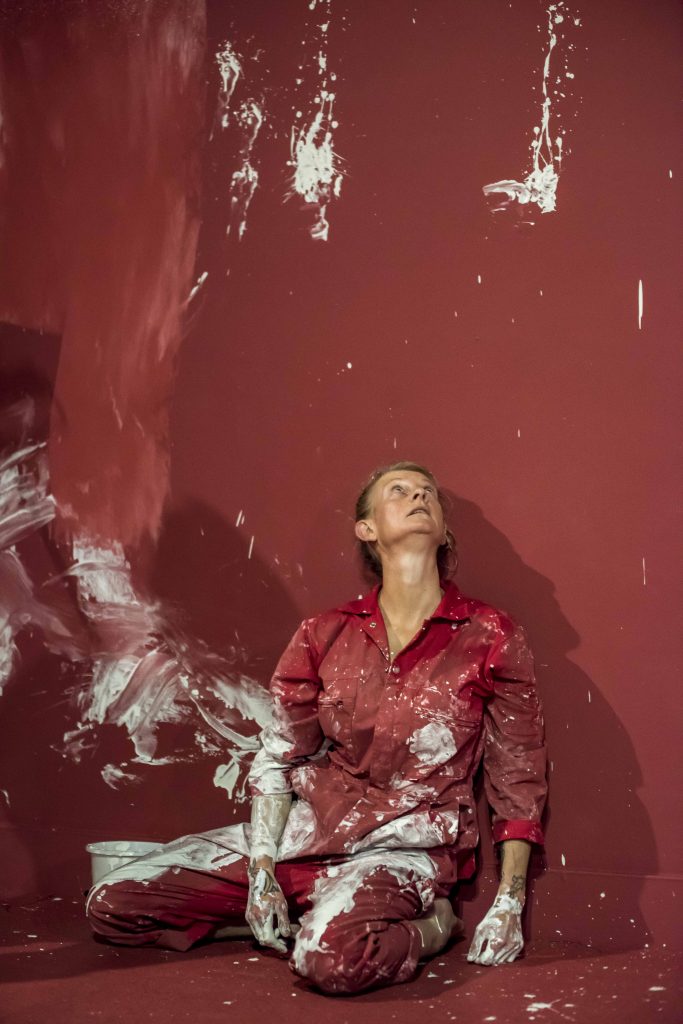
The evening ends with a performance by movement practitioners, one of a number of activations which are collectively titled ‘Erasure and Irrepressible Palimpsest’ (2026). Two people in red boiler suits carry paint – one splashes white paint against the walls, whilst the other chases them with a roller of red paint, trying to cover it up. The visual effect of the white splashed up the walls is the inverse of spilt blood on white. The performance, whilst playful, had a silencing effect on the audience. At times, the person thrashing against the wall with white paint is far ahead, and the person with the red is racing to keep up; at others it is more interactive, with their body literally being painted over as though it were part of the wall. As the performance progresses, the red paint blends with the white to create more of a pink colour, and I wonder whether it represents the way grief spills over and the desire to try and contain it. But then performers switch roles halfway around the room, so perhaps the performance represents a different duality, I wonder, perhaps the one all the others stand in for, the one between life and death.
Florence Peake: Vitalities, HOME, Manchester, 10 October 2026 – 31 January 2027. Dates of further activations and events, including the curator tour and talk, are listed on the HOME website.
Grey Marlow is a writer and they founded The Grey Area, a queer and trans bookshop based in Manchester.
This review is supported by HOME.
Published 06.11.2026 by Jazmine Linklater in Reviews
1,232 words