Rough Terrain brings together ten artists working in, on, and about Cumbria. The exhibition’s curatorial framework draws on the writing of environment campaigner Marion Shoard, known for coining the term ‘edgelands’. In her articulation of the interfacial landscapes between urban and rural, Shoard calls for ‘expression[s] of the dynamism that the interface enshrines’. Rough Terrain sets out to meet this call and quickly expands upon it. Again and again, the artists featured turn their attention towards that which has been discarded, obscured, marginalised, buried or otherwise pushed to the edge. Nuclear waste. Broken furniture. Regional dialect. Queer communities. Rural folklore. Fragments of images and infrastructure. Throughout the exhibition, the artists assert that value is not found in the centre but in the periphery.
Cumbria is frequently represented through a narrow set of images, many of which I was treated to on the train ride through it: lakes, mountains, dry stone walls, grazing sheep. Cumbria’s landscape is present throughout Rough Terrain, but rarely in its most familiar form. The exhibition text welcomes visitors to the ‘REAL Cumbria’. While this phrase risks sounding like a line from the local tourist board, the artworks themselves offer something more nuanced. They refuse a singular definition of this place, opting for something more tangled, more barbed.
The first artworks to snag my attention are Anna Clough’s pair of sculptural vessels, composed of sand, plaster, soil, canvas, paper pulp and other materials. ‘Hod’ (2026) sits low and ‘Tools for looking (1)’ (2025) perches high. Their surfaces appear ancient, roughened and corroded as though subjected to centuries of weathering. They resemble archaeological artefacts excavated from some unknown civilisation and hint at communal practices, systems of care, and ways of being together that have been dropped from the historical record.
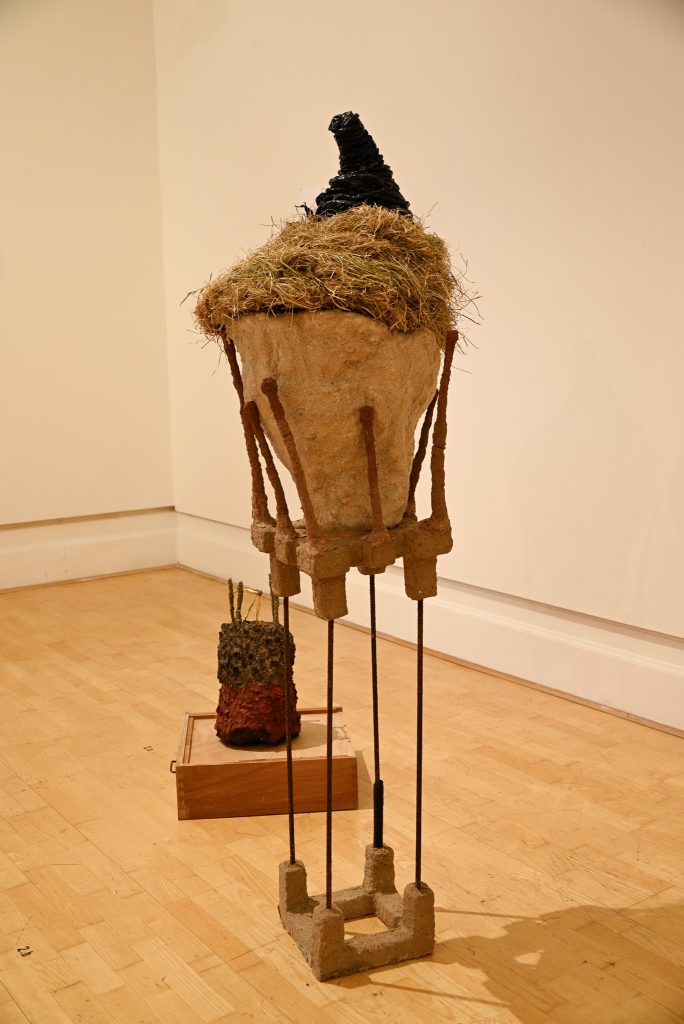
However, Clough’s use of industrially produced steel rods and found plastics suggests that these objects belong to the present or perhaps even an imagined future. They are strikingly impermanent, a quality that the artist leans into across her practice. Clough composes her sculptures from locally sourced materials, which she frequently reworks and replaces, allowing some elements – such as hay or newspaper – to decompose or be composted.
I am reminded of Ursula K. Le Guin’s influential essay, ‘The Carrier Bag Theory of Fiction’, in which she proposes an alternative origin story for human culture. Rather than centring weapons, conquest and heroic narratives, Le Guin suggests that ‘before the tool that forces energy outward, we made the tool that brings energy home’. Clough’s vessels feel like carrier bags in this expanded sense. They assert that survival is not achieved through domination but through maintenance, adaptation and collective acts of holding.
Nearby, Marisa Crane presents a cluster of small sculptures, which gather together as if seeking comfort or aid. Titled ‘The Woods The Trees (Rewilded)’ (2026) and assembled from fragments of broken family furniture, Crane’s sculptures evoke woodlands devastated by fire; charred trunks protruding from a thick layer of ash. In a similar manner to Clough’s vessels, they speak of an aftermath whilst hinting at what might emerge from the ashes: dormant seeds and new growth. These humble works insist on the significance of the abandoned, a sentiment that permeates the entire exhibition.
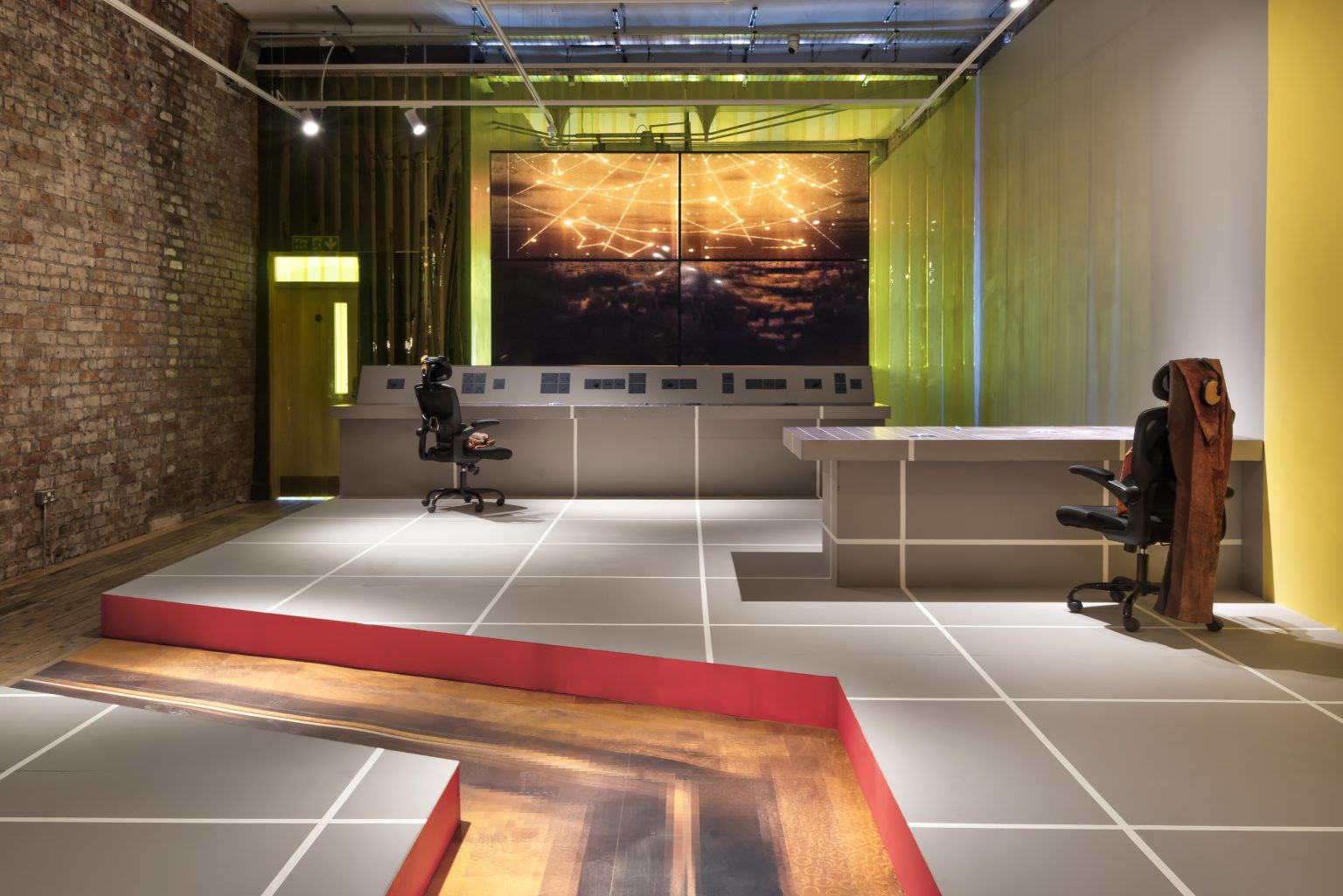
Whilst Crane’s sculptures barely reach my knees, the exhibition’s back wall is dominated by a cinema-scale projection of ‘Workington Red’ (2019), by Julia Parks. The 16mm film is a dreamlike and associative exploration of the impact of heavy industries on West Cumbria’s landscape, which weaves together song, spoken interviews, and archival footage.
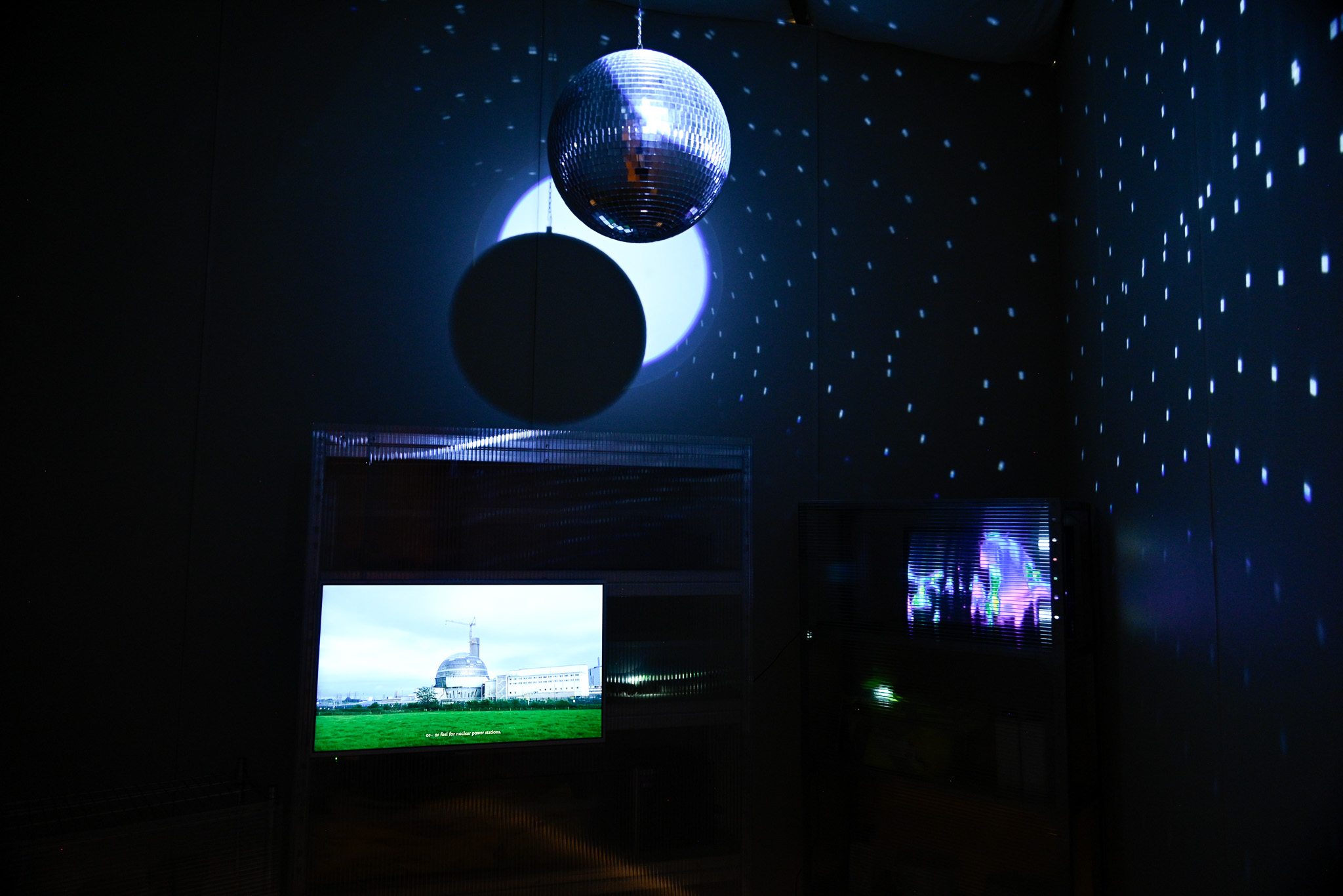
Alistair Debling’s video installation, ‘Half Lives’ (2023-24), is simultaneously ominous and tender. Developed through research into Sellafield (the large multi-function nuclear site on the county’s coast) and Cumbria’s LGBTQ+ communities, the work draws subtle connections between queerness and the complex work of decommissioning a nuclear reactor.
Sellafield itself occupies a peculiar position within the British imagination. It was the site of the 1957 Windscale fire, one of the world’s worst nuclear incidents, yet it feels strangely absent from the public consciousness. Vast, consequential and heavily regulated, it simultaneously necessitates attention whilst resisting visibility through its infrastructure and ‘cover-up culture’.
Like his subject matter, Debling’s video installation and accompanying photo series repeatedly frustrate acts of looking. Photographs developed using wildflowers are presented behind sheets of Perspex with differing levels of transparency. High-visibility jackets are distorted behind corrugated plastic. Thermal imaging cameras render bodies as maps of heat and blow out identifying features. The central video is laced with point-cloud visualisations that become increasingly diffuse as proximity increases. This imagery is accompanied by the voices of members of Sellafield’s LGBTQ+ network. Their testimony is deftly edited to create blurred stories of closeted lives, radioactive decay, the mutability of language, gender transition and nuclear semiotics.
Their words are underpinned by an electronic soundtrack reminiscent of a Geiger counter, an electronic device that transforms invisible radioactive decay into an audible form. As the sound accumulates, it builds into a minimal techno track, which walks a fine line between warning and club anthem. Sonically, visually, and thematically, Debling asks in multiple registers: what must remain hidden in order for survival?
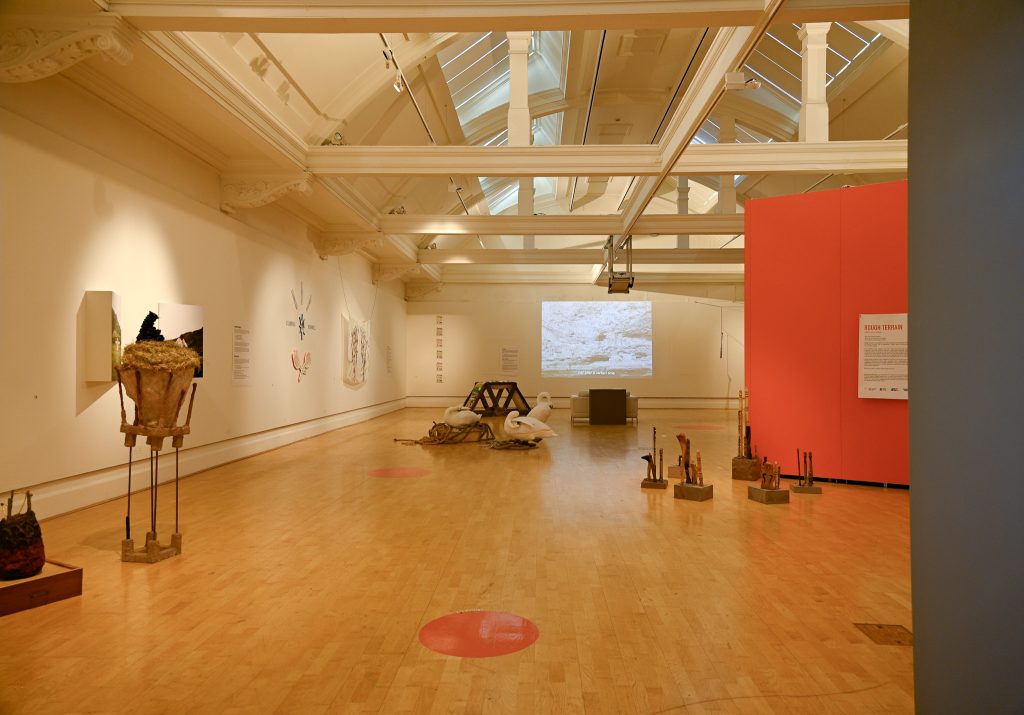
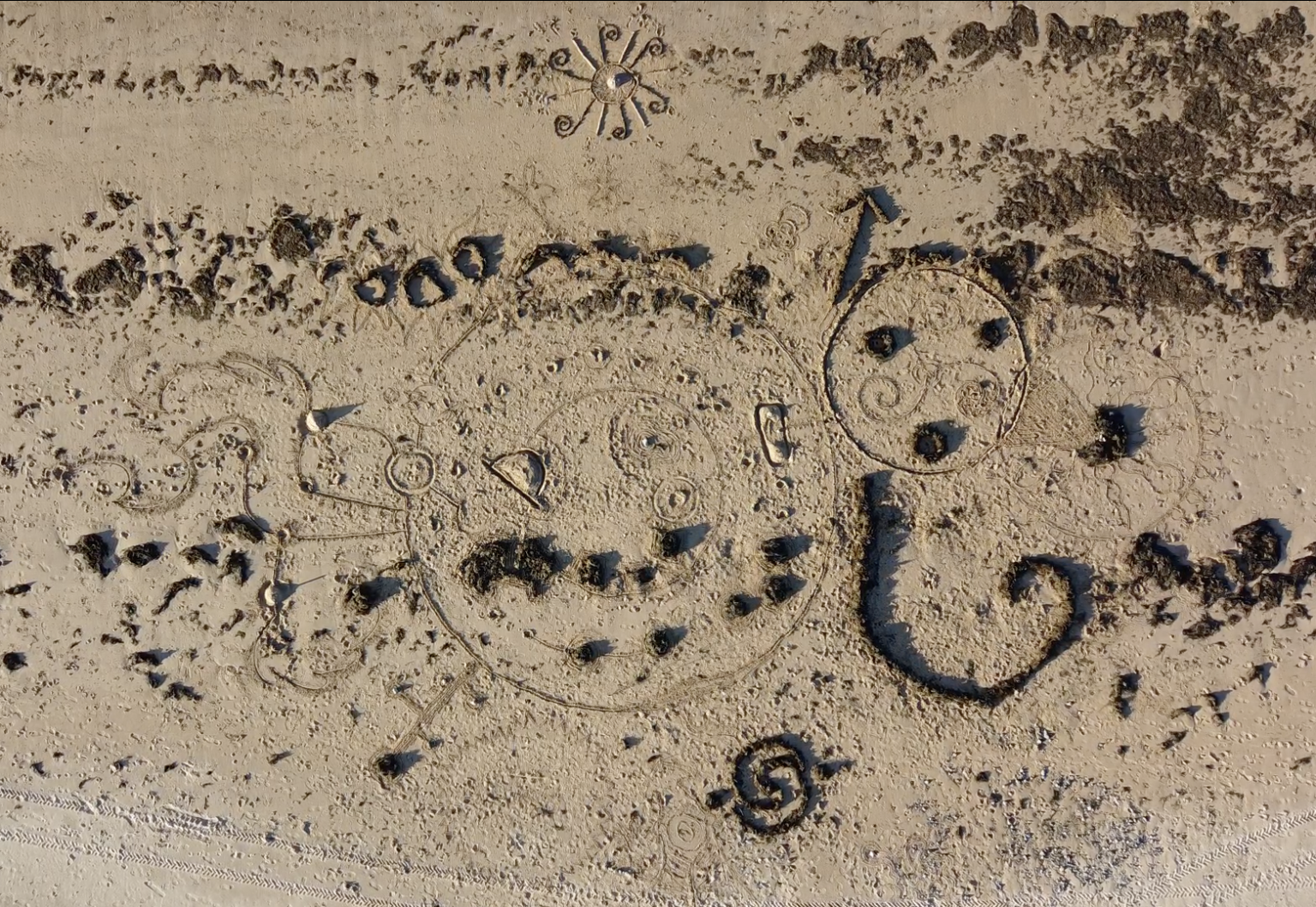
Nuclear concerns surface elsewhere through Conor (Cj) Pitcher’s installation, ‘Nuclear Communications Research Repository (NCRR) Volume One’ (2026). Described by the artist as an ‘exploded sketchbook’, photographs, protective suits, glyphs, votive offerings and sculptural objects are compiled in a manner that feels simultaneously devotional and forensic. The work draws on the field of nuclear semiotics, an area of research concerned with an extraordinary problem: how might humanity communicate the dangers of nuclear waste to future societies tens of thousands or even hundreds of thousands of years from now?
The challenge is difficult to overstate. Nuclear waste will remain dangerous for periods of time that vastly exceed existing political systems, languages and cultural traditions. There is no guarantee that future beings will understand our symbols, read in the same direction or associate the same colours with danger. Among the more speculative proposals emerging from nuclear semiotics is the concept of an Atomic Priesthood; a group tasked with carrying knowledge of nuclear sites across generations through ritual and storytelling.
Pitcher’s installation embraces the strangeness of this proposition and sets out to establish such a group. Hooded decontamination suits acquire an almost liturgical quality. Materials used in nuclear waste containment take on the role of relics. Playful texts imagine stories the priesthood might spread. Pitcher isn’t merely entertaining the idea of an Atomic Priesthood; he appears genuinely invested in its underlying challenge.
Surrounded by artworks addressing contamination, toxicity and environmental transformation, I find myself reading Jocelyn McGregor’s hybrid swan-human sculptures through the lens of cellular mutation. ‘Dredged (preening swan lying down)’, ‘Dredged (preening swan standing up)’ and ‘Dredged (preening swan on one leg)’ (all 2023) all depict swans whose elegant necks are formed from cast human arms, with pinched fingers describing beaks. The transformation is remarkably economical. At first glance the figures appear convincingly avian. Then something slips, the illusion falters and familiar anatomy reasserts itself. The resulting sensation is not horror but estrangement. These sculptures are a reminder of how strange living bodies already are. In the blurring of human and animal, some things become more clear. McGregor’s sculptures suggest that categories we often treat as stable are in fact processes of becoming. This is an idea that echoes throughout Rough Terrain, where categories repeatedly break down and unexpected affinities emerge between seemingly disparate subjects.
A similar instability appears in Lydia Moraitis’s, ‘Tied Down’ (2026); two sculptures of bright pink, screenprinted legs kick up through the gallery floor. One wears a lace garter, the other a sturdy rope. Their fragmentary forms and toxic colour palette unsettle any straightforward reading of the body. This is an idea that persists throughout Rough Terrain, where categories break down and unexpected affinities emerge.
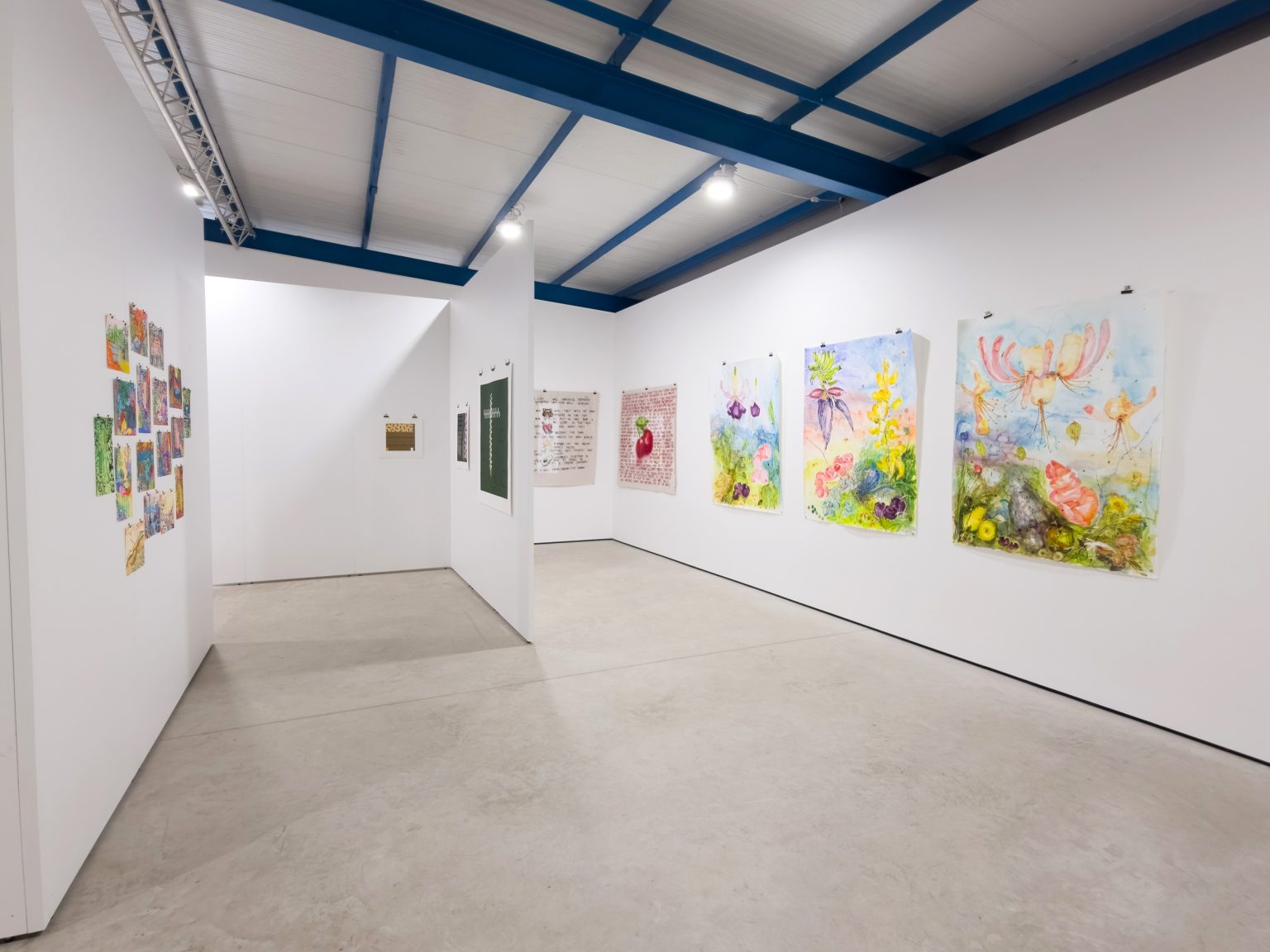
This collapsing of boundaries also animates Jamie Bradley’s idiosyncratic protest banner (2018). The painted silk depicts two human bodies comprised from delicate blooms of colour. The marks are at once contained and overflowing; purples, pinks and greens suggest wildflowers emerging from a dry-stone wall or foxgloves finding purchase in unlikely places.
Across the composition stretches the artwork’s title, ‘Gammerstang’, a Cumbrian term described as being ‘associated with a particular feminine unease’. Bradley reclaims the word; a gesture that resonates with broader histories of queer language and reminds me of the coded vocabulary of Polari. Words often carry the sediment of previous uses, previous prejudices, previous assumptions. Yet language is also mutable, endlessly available for reinvention or reclamation.
Whilst ‘Gammerstang’ is most obviously read as a banner or flag, which claims territory in the edgelands for queer sissydom, I am also reminded of burial shrouds. This tension between visibility and vulnerability is compelling. Celebration is not distinct from mourning. Instead, Bradley suggests that acts of queer self-definition are often inseparable from acts of remembrance, from carrying forward words, lives and ways of being that might otherwise disappear. In this sense, ‘Gammerstang’ becomes less a marker of territory than a vessel for community.
Questions of place and belonging emerge in Juliet Klottrup’s film, photo series and zine, ‘Skate Like a Lass’ (2025). The project documents grassroots skate communities comprised of female, marginalised and LGBTQIA+ people. In the zine, Lily – a skateboarder and member of Cumbria Cvven – asserts that it doesn’t matter that they’re not in a city, because ‘you can skate anywhere’. It is a deceptively simple statement. Skateboarding has always been a practice of adaptation, of finding possibility within environments that aren’t for – or are actively against – it. Kerbs become obstacles. Handrails become opportunities. Waste ground becomes a chance to gather.
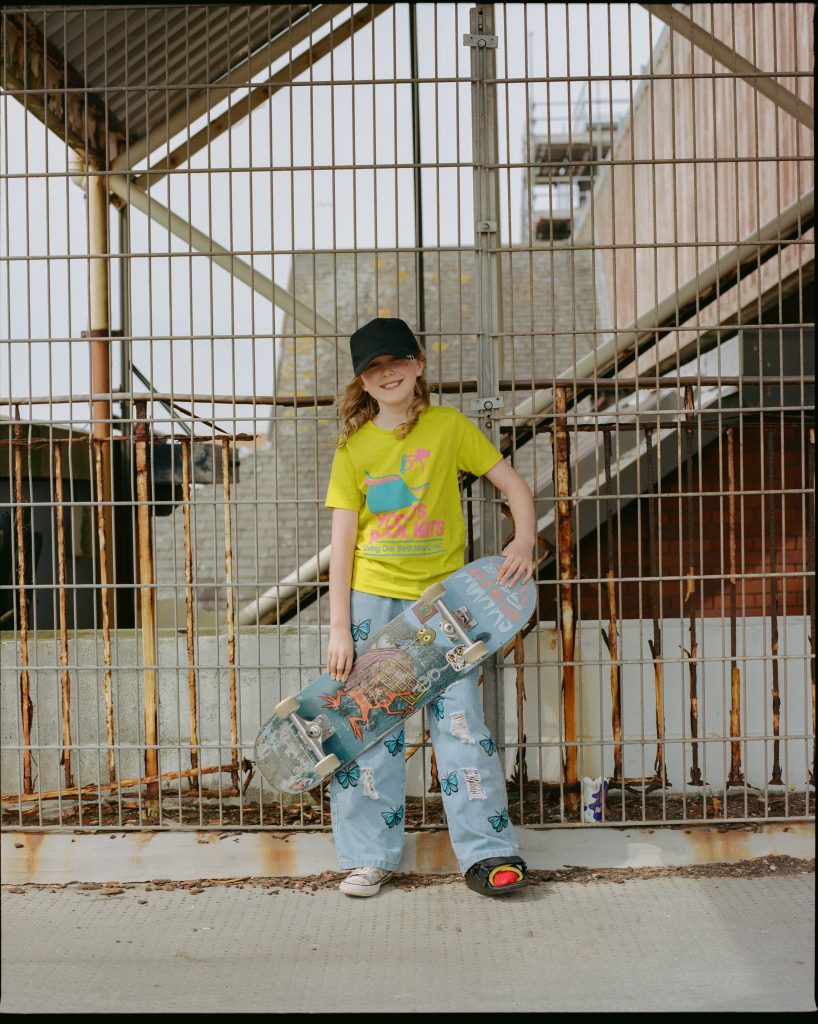
‘Skate Like a Lass’ captures this resourcefulness beautifully. But it is also in dialogue with skateboarding’s mainstream, which has long been male-dominated and is increasingly influenced by high-profile competitions, multinational corporations and private equity firms. The communities Klottrup centres aren’t in it for money or medals. They do it for the love.
A related sensibility appears in Iona Ford’s photographic works, which relocate rural folk traditions into urban settings. Presented as documentation, their slight dislocations generate a productive uncertainty. In ‘ANONYMITY’ (2024), a person sits aboard a bus, their eyes and head concealed by strips of patterned cloth, as red brick houses streak by. Customs associated with one landscape are transplanted into another. Rural and urban identities cease to function as opposites. Boundaries become porous.
This interest in overlap is what ultimately gives Rough Terrain its strength. Rather than presenting Cumbria as a fixed entity, the exhibition approaches place as something continuously negotiated through relationships, histories, materials and acts of imagination. The artists repeatedly return to things that have been neglected, obscured or discarded, not in order to rescue them, but to demonstrate that they were never without value.
Descending the staircase of the Nan Tait Centre – the former technical school that houses Art Gene – I pass through reception and cannot help but note the organisations who share this building: the local registration office, an organisation supporting vulnerable women, an alcohol-free music venue. Art takes its place in a wider ecology of care, administration and community. Le Guin’s carrier bag theory once again feels pertinent. Her argument is that culture is not primarily built through acts of conquest but through acts of gathering. The carrier bag collects disparate things and allows them to coexist. In many ways, Rough Terrain functions similarly. It gathers stories, materials, communities and contradictions without forcing them into a singular narrative. Nuclear waste sits alongside queer histories. Folk traditions sit alongside skateboarding. Ancient-looking vessels sit alongside speculative futures.
The result is an exhibition that feels expansive without becoming diffuse. Whilst it centres Cumbria, it speaks to broader questions about how communities remember, adapt and endure. Time and time again, the artists reveal value accumulating in overlooked places: seeds taking root amongst rubble, forms of knowledge persisting beyond official histories, identities flourishing beyond the limits imposed upon them.
What happens in the margins? According to Rough Terrain, quite a lot. Things grow there. Things survive there. Things accumulate. The exhibition does not offer definitive answers. Instead, it demonstrates that the margins are never empty. They are the rough terrain from which new possibilities emerge.
Rough Terrain, Art Gene, Barrow-in-Furness, 17 – Friday 3 July by appointment.
Chris Alton is an artist and curator based in the Calder Valley, West Yorkshire.
This review is supported by Art Gene. Rough Terrain is presented as part of See It To Be It, a Cumbria Arts and Culture project.
Published 26.06.2026 by Jazmine Linklater in Reviews
2,089 words